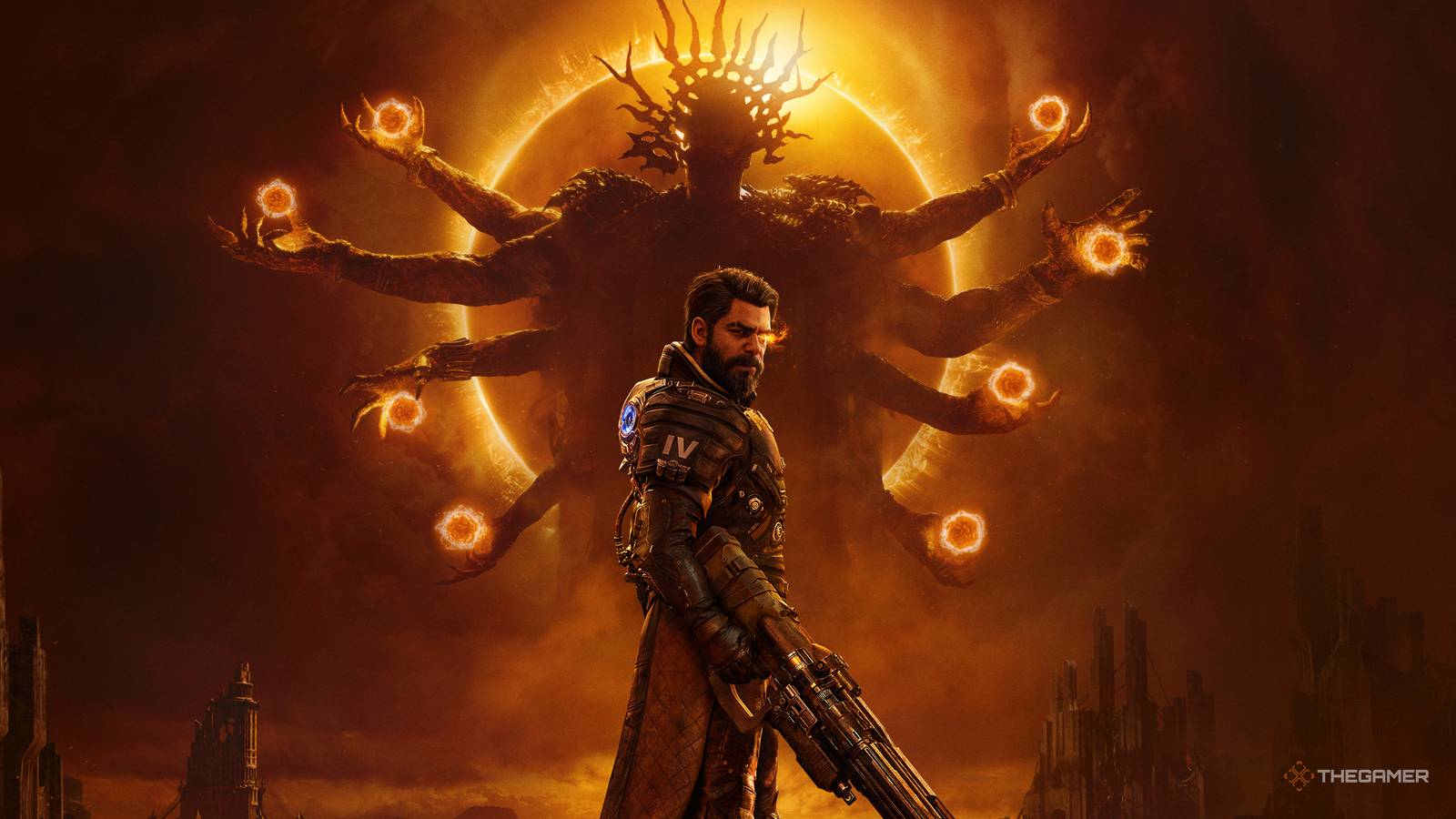
I will be the first person to admit that I hate dying in video games. I protect my inventory at all costs, lower the difficulty so I feel divine in battle, and avoid any unnecessary challenges that might set me back. I'm not a risk taker, and that's okay. So when Saros landed on my desk, I knew it would rattle my heart.
This latest roguelike shooter outing from developer Housemarque strikes the perfect balance between surviving and thriving. If you die, you'll lose your artifacts, but you'll get something much more valuable in return: experience. Experience that can be used to continue fighting, grinding and learning more about how to survive amidst its harsh alien world.
Saros wants you to fail

The first time I died in Saros I was disappointed. The supervisor sent me (or Arjun Devraj, portrayed by Rahul Kohli) rapidly ragdolling across the battle arena. Before I could feel sorry for myself, I realized that this early defeat was secretly a good thing. Only the strongest players are likely to defeat this first opponent and live to tell the tale. I licked my wounds and used it as a learning experience and a way to keep moving forward and getting better.

Diablo 4: Lord Of Hatred Review – Darkness In A New Light
Diablo 4: Lord of Hatred surprised me with its sunlit setting and stronger narrative focus.
In the first few moments of the game, an ethereal woman's voice calls out to you, pleading with you to find her. Arjun answers her and promises to find her, but his voice doesn't seem to reach her. Getting to grips with the controls is easy enough, but all I wanted to do was follow the woman's voice towards the golden sun.
Alas, my death prevented that. Instead, I awoke to find the dangerous planet of Carcosa in chaos – and that was just the beginning. Without giving too much away, my first couple of runs through an opening area known as Shattered Rise felt fruitless, but I didn't give up at any point.
Each “life” in Saros is known as a cycle, and your cycles are graded as you return to base. Some cycles will be longer and more rewarding than others, but it's all part of the gamble as you step outside the safety net of the ruins to try and find the lost colony on Carcosa. Like many games in this genre, each death is a lesson that makes you stronger, helping you learn the patterns of each enemy and boss, before stepping back into battle with greater preparation.
When you die the map will change. The enemies across each stage will also evolve and adapt to your strategies, leaving you with an eerie sense of discomfort no matter where you are in the campaign. When you die, it's like unlocking another puzzle piece. Eventually you will have everything and can complete the level without much trouble, but you have to earn the right to such a victory.
A versatile cast keeps morale up

Despite all that is happening on the desolate planet of Carcosa, the wide variety of characters you embark on this quest provides with both diverse backgrounds and unique interactions for you to engage with. The team isn't the first set of people sent to Carcosa – it's the fourth, and the first three are MIA.
Everyone is tired, scared and about to crash if one more thing goes wrong on this godforsaken rescue mission. Some of your closest allies went rogue, others stared into the sun and walked off a cliff, and one of your teammates sabotaged the ship, effectively stranding you and the others on this nightmare planet that was supposed to be devoid of life, all in search of a valuable resource, Lucenite, that your benefactor, the Soltari Corporation, believes will solve Earth's current power problems.
It seems the corporate overhaul strikes again, as the company has cut corners and prioritized the extraction of Lucenite over the missing colonists, but thankfully Arjun has a conscience.
There's no reason for hope given the circumstances, but each character has a reason to believe they just might make it home. But no matter how many times you die and reform in a strange pool of aliens in these ruins, no one bats an eye. No one questions the odds of success when their strongest soldier looks like he's just been through a meat grinder for the umpteenth time. If you're willing to keep moving, why wouldn't they?
It's a mix of pure desperation and hope where some determined survivors have no choice but to rely on each other if they want to get out of life. I felt my resolve strengthened with each audio log I collected in the field, and I heard the voices of those who came before me trying to justify this mission. It can't be for nothing. Good old corporate greed wouldn't risk thousands of lives just to get a quick buck.
For legal reasons this is a joke.
Saros makes you feel like an action hero

Despite being crushed countless times by larger-than-life aliens with glowing projectiles, Arjun feels like a true hero. He has his secrets, but effectively sets aside his paranoia to prioritize the mission. He has things to do, and no ancient civilization or changing planet will stop him.
Even as you pass massive statues of bodies trying to get away, as if stepping on each other to escape a bygone catastrophe, Arjun remains focused. The monochromatic planet drips with red flora that move with a mind of its own, replicating the cephalopod movements of the aliens that inhabit the ruins. I know I have a million questions about what's going on, but Arjun doesn't.
He obliterates enemies with energy-based weapons that you pick up from the map. At first the standard pistol feels like it's holding you back from great things, but the second I got the hand cannon I realized what power really is. My bullets exploded into the octopuses, scattering dirt and projectiles everywhere.
Arjun's shield absorbs these projectiles and redirects them as an energy blast that not only melts enemies, but opens up hidden passages around the map. I kept my finger on the trigger during most of my runs, just in case a monster rushed out of my blind spot. Thankfully, response times are quick, but the mechanics keep you on your toes. Saros pushes you to explore if you really want a foot in the world or risk being crushed.
Similar to Saro's predecessor, Returnal, that's all feels Good. The two are similar in their “keep dying” mechanics, but vary in difficulty. While Returnal is punishing, and your victory is subject to RNG more than skill at times, Saros feels more welcoming. Sure, having the right gear makes it easier, but you can also use multiple tools at your disposal to last just a little longer and defeat bosses without the optimal loadout.
When you die, Arjun reforms and you're told how long you've been gone – over time rebuilding Arjun's body takes more and more time as you progress. You can learn a lot about the mission every time you return to the base by picking up text logs and exploring the ruins. The story is more than just the main road, with additional insight into your past and the history of the crew there.
It feels like one big adventure, and you're only introduced to one piece at a time. Delving into the depths of an alien planet would usually be disturbing to me as a casual gamer, but Carcosa's world enticed me. Who is the mysterious voice lingering in Arjun's head, what happened to the colony and the crew, and how on earth am I supposed to beat the tutorial boss on my next run?

Saros


4.0/5
- Released
-
30 April 2026
- ESRB
-
Teen/blood, language, mild suggestive themes, violence
- Publisher
-
Sony Interactive Entertainment

- The game feels fresh when the map changes
- Fast-paced shooting mechanics keep the combat light but engaging
- Haunting music and images
- Easy to get lost
- Losing artifacts on death means starting a new cycle from square one
