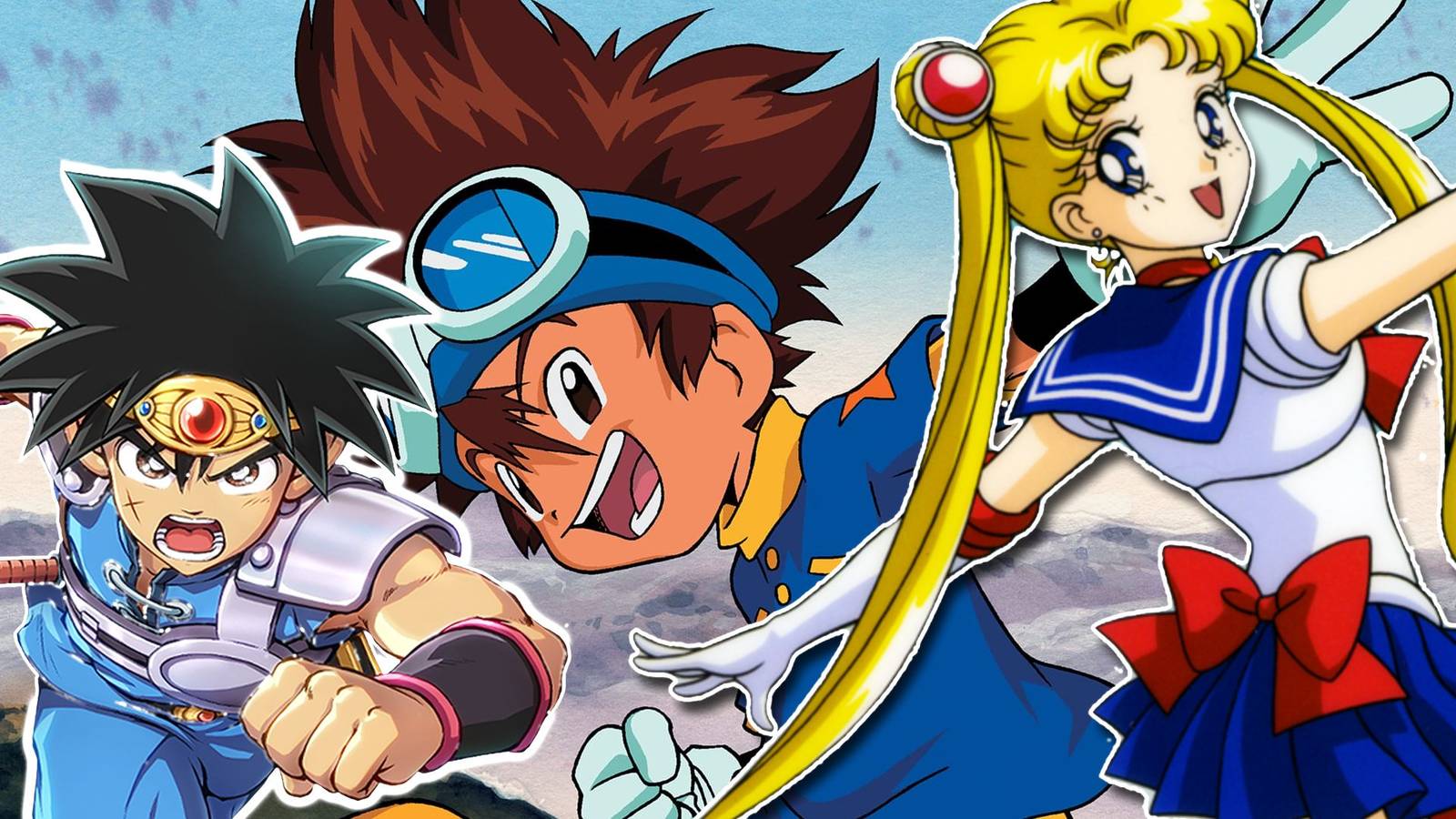
The 1990s were a pivotal decade for anime. Not only did major franchises debut throughout those years, but many of them also made their way internationally and introduced anime to fans outside Japan. If Demon Slayer or Jujutsu Kaisen are such massive hits today, it’s thanks, in part, to how those iconic series paved the way from the late ’80s through the 2010s.
While this is a daunting task, here are the best anime from each year of the 1990s. For instance, since many anime aired continuously for years, we will only consider the premiere year of a series (including anime divided into multiple seasons, like Sailor Moon).

35 Best Anime From The 90s, Ranked
The 1990s were a great time for anime, and several series from the era remain popular today. Here are the best anime from that decade.
1990
Nadia: The Secret of Blue Water

|
Japanese Title |
Fushigi no Umi no Nadia |
|
Number of Episodes |
39 |
|
Original Broadcast |
1990–1991 |
|
Studio |
Gainax, Group TAC, Sei Young Animation (assistance) |
|
Japanese TV Network |
NHK |
The story is set in 1889, in an alternate universe, and follows Nadia, a teenage girl, and Jean, a French inventor. In a time of many scientific and technological discoveries, Gargoyle wants to restore the lost Atlantean empire through any violent means necessary. On a submarine, Nadia, Jean, and Captain Nemo must save the world from this new threat.
Nadia is an original anime series created by Hideaki Anno, whose concept was created decades earlier, during the 1970s, by Hayao Miyazaki, loosely based on Jules Verne’s Twenty Thousand Leagues Under the Sea and Around the World in Eighty Days. Although the series didn’t enter production back then, Toho retained the rights. Years later, Gainax pitched it to NHK, initially with Hiroaki Inoue leading the project. However, due to internal power struggles in Gainax, Inoue was eventually removed and replaced by Anno.
Who’s That Character?
Identify the silhouettes before time runs out.
Identify the silhouettes before time runs out.
Easy (7.5s)Medium (5.0s)Hard (2.5s)Permadeath (2.5s)
The production was costly, causing Gainax to incur heavy losses, and, in the end, the studio had no rights to the series. Curiously, Neon Genesis Evangelion was initially planned as part of the Nadia universe, but since the studio wasn’t able to secure the rights to Nadia, Evangelion shifted to a completely original series (and would go through many struggles during production). Group TAC requested Gainax to produce a movie, but the studio eventually withdrew from the project, and TAC produced it alone. While the series was generally well received, the sequel movie received harsh criticism.
In the US, the series was first released on DVD and VHS by ADV Films and also aired on Anime Network. Later, Sentai Filmworks acquired the rights to the series. More recently, GKIDS re-licensed and released it in 4K on Blu-ray.
Nadia is available to watch on Amazon Prime Video and RetroCrush in the US.
1991
Dragon Quest: The Adventure of Dai

|
Japanese Title |
Doragon Kuesuto: Dai no Daibouken |
|
Number of Episodes |
46 |
|
Original Broadcast |
1991–1992 |
|
Studio |
Toei Animation |
|
Japanese TV Network |
TBS |
The anime follows Dai, an ordinary young boy who grew up listening to his adoptive grandpa’s stories about the fight between the hero Avan and the Demon King Hadlar, which brought ten years of peace to their land. However, their peaceful life is interrupted as Hadlar is revived. Dreaming of becoming a hero himself, Dai embarks on an adventure to defeat the emerging evil forces.
The anime is based on the manga of the same name written by Riku Sanjo and Koji Inada (which is, in turn, based on the popular gaming franchise Dragon Quest, but not on any individual entry). The animation was popular back then, and it was also released internationally in many Asian, European, and Latin American countries in the 1990s, although it hasn’t been officially released in the US.
Interestingly, in many countries, Dai’s name was changed to “Fly” because the Japanese name sounded like “die” (even though English was not spoken in many of these countries). A remake was produced and broadcast from 2020 to 2022, which is available on Crunchyroll, Netflix, and potentially other platforms.
There were other amazing TV anime released in 1991, such as the Minky Momo sequel and City Hunter ’91. While The Adventure of Dai could be considered a typical shonen, it is such a charming and engaging story, with great animation for its time, that it deserves to be ranked as the best of the year. It’s simply a lot of fun to watch.
The first Dragon Quest: The Adventure of Dai anime is unavailable to stream in the US.
1992
Pretty Guardian Sailor Moon
|
Japanese Title |
Bishoujo Senshi Seeraa Muun |
|
Number of Episodes |
200 (+ specials) |
|
Original Broadcast |
1992–1997 |
|
Studio |
Toei Animation |
|
Japanese TV Network |
TV Asahi (ANN) |
Sailor Moon is originally a manga by Naoko Takeuchi, which ran from 1991 to 1997 in Kodansha’s Nakayoshi. The story starts when Usagi Tsukino (Serena in the original English dub), an ordinary schoolgirl, finds a talking cat named Luna, who tells her that she is actually the reincarnation of Sailor Moon.
From that day on, Usagi fights evil threats dressed as Sailor Moon. She is later joined by other girls, and they fight evil in a Super Sentai-style squadron. The series blends their lives as heroines with their ordinary daily lives as schoolgirls, combining action, drama, and romance (and some episodes can be pretty scary).
1992 also saw the premiere of two other heavy hitters. One was Yu Yu Hakusho, and, interestingly, Yoshihiro Togashi and Naoko Takeuchi would end up marrying a few years later. The other was Crayon Shin-chan, which has become one of the most famous and long-lasting humor franchises in Japan. Both Sailor Moon and Yu Yu Hakusho could be considered landmarks, and both had extremely high-quality anime adaptations. However, Sailor Moon had such a huge impact, reshaping the entire magical girl genre, that it seems impossible for any other production released in 1992 to surpass it.
Sailor Moon is available to watch on Amazon Prime Video and Hulu in the US.
1993
Slam Dunk
|
Japanese Title |
SLAM DUNK |
|
Number of Episodes |
101 |
|
Original Broadcast |
1993–1996 |
|
Studio |
Toei Animation |
|
Japanese TV Network |
TV Asahi (ANN) |
Slam Dunk is perhaps the most popular basketball manga/anime franchise in the world. Instead of focusing on a prodigy or a passionate protagonist, as many sports manga do, it follows a gang leader and delinquent, Hanamichi Sakuragi, who is a first-year student at Shohoku High School. Sakuragi doesn’t even want to join the basketball team because he thinks it’s a sport for “losers,” yet ends up doing it to impress the girl he has a crush on. During the story, Sakuragi slowly discovers his love for the sport.
The anime adaptation of Takehiko Inoue’s manga was very popular in Japan. It was the most prominent and definitely the best release in 1993 (excluding Sailor Moon R, which is the second season of the Sailor Moon anime), and it remaisn as one of the best sports anime of all time. Other notable releases were Miracle Girls, Ninjaboy Rantaro, and Mobile Suit Victory Gundam. A movie titled The First Slam Dunk was released in 2022, broke many records but it’s almost forgotten today.
Slam Dunk is available to watch on Amazon Prime Video in the US.
1994
Magic Knight Rayearth

|
Japanese Title |
Majikku Naito Reiaasu |
|
Number of Episodes |
49 |
|
Original Broadcast |
1994–1995 |
|
Studio |
TMS Entertainment |
|
Japanese TV Network |
Nippon TV, Yomiuri TV (NNS) |
Magic Knight Rayearth is one of those 1990s anime that quickly made a name for itself in Japan and internationally, and it’s a foundational example of isekai series. The series follows three schoolgirls who are suddenly transported into a magical world, where they are supposed to rescue a princess. The show also features mecha elements. The anime adapts the manga of the same name written by CLAMP.
The series featured great animation (given the technology at the time) and spawned several OVAs and, more recently, a remake, slated to air this year. It outshone any other release of 1994, such as Macross 7, Captain Tsubasa J, and Final Fantasy: Legend of the Crystals.
Magic Knight Rayearth is available to watch on Netflix and Crunchyroll in the US.
1995
Mobile Suit Gundam Wing
|
Japanese Title |
Shin Kidou Senki Gandamu Uingu |
|
Number of Episodes |
49 |
|
Original Broadcast |
1995–1996 |
|
Studio |
Sunrise |
|
Japanese TV Network |
TV Asahi (ANN) |
Gundam Wing is set in a new timeline and not in Gundam 0079‘s Universal Century timeline. The plot revolves around a massive war between Earth and space colonies, focusing on five teenagers who pilot mobile suits and rebel against the United Earth Sphere Alliance. Therefore, it is a great entry point to the franchise, which may be one of the reasons why this series helped the franchise go mainstream internationally. It’s probably more beloved in the US than in Japan, even though it was also a hit in Japan.
1995 was big for the mecha genre since Neon Genesis Evangelion was also released that year. Choosing which is better between these two giants is a tough call, since they are both great anime. While Evangelion focuses more on the characters and their psychology, Gundam Wing has more action and shows a lot of political intrigue and the consequences of war.
Gundam Wing is available to watch on Hulu and Crunchyroll in the US.
1996
Dragon Ball GT

|
Japanese Title |
Doragon Booru GT |
|
Number of Episodes |
64 |
|
Original Broadcast |
1996–1997 |
|
Studio |
Toei Animation |
|
Japanese TV Network |
Fuji TV (FNS) |
Dragon Ball GT is a sequel to the Dragon Ball Z anime, but it takes a more humorous tone than its predecessor (not that DBZ didn’t include any humor at all). Because of a wish Pilaf and his gang made to Shenron, Goku is turned into a child and goes on an adventure through space alongside Trunks and his granddaughter Pan. Their goal is to collect the Black Star Dragon Balls and turn Goku back to his normal form.
This might be a strange choice for some, but Dragon Ball GT was a series in which Toei Animation invested heavily and that tries to bring back the adventure vibes of the original Dragon Ball anime (just like DB DAIMA). While many Dragon Ball fans hate it, the series has also built a loyal fanbase. Even though series like Boys Over Flowers, Detective Conan/Case Closed, and Saber Marionette J premiered that year, it’s hard to say any of them could surpass Dragon Ball GT that year, even though some may prefer their plots over DBGT‘s (besides, DBGT is extremely fun to watch).
Dragon Ball GT is available to watch on Crunchyroll, Hulu, and Amazon Prime Video in the US.
1997
Revolutionary Girl Utena
|
Japanese Title |
Shoujo Kakumei Utena |
|
Number of Episodes |
39 |
|
Original Broadcast |
1997 |
|
Studio |
J.C. Staff |
|
Japanese TV Network |
TV Tokyo (TXN) |
Revolutionary Girl Utena is another magical girl series that aired in the 1990s and had a strong impact on the genre, mostly because of the subversive way it approaches classic magical girl tropes. It follows Utena Tenjou, a tomboy schoolgirl who ends up involved in weird sword duels that take place on top of the school. The winner of all the duels becomes engaged to the Rose Bride, Anthy Himemiya, and earns the “power to revolutionize the world.”
Not understanding much about what’s going on, Utena starts building a relationship with Anthy and develops a growing desire to protect her from violent suitors and eventually free her from this role. As the story progresses, it also follows Utena on her journey of self-discovery (including falling prey to manipulation).
1997 was a big year for anime. Besides Utena, many other strong titles debuted in Japan, such as Pokémon, the first Berserk anime, and the Doctor Slump remake. However, Utena is such a dense coming-of-age story with an original concept, great animation, and a cast of deep characters that it is hard not to consider it the best anime release of that year.
Utena is unavailable to stream in the US.
1998
Initial D First Stage

|
Japanese Title |
Inishiaru D |
|
Number of Episodes |
26 |
|
Original Broadcast |
1998 |
|
Studio |
Studio Comet, Studio Gallop |
|
Japanese TV Network |
Fuji TV (FNS) |
Initial D is an anime adaptation of the street racing manga of the same name. The story follows Takumi Fujiwara, who spent years improving his driving skills by making tofu deliveries for his father in his Toyota Corolla Sprinter Trueno, better known in-story by the code AE86 (or simply “86”). Once Takumi accidentally joins the racing scene, he soon becomes quite famous for beating experienced drivers in such a simple and old car.
While there were many strong releases that could be considered the best of 1998, such as Cardcaptor Sakura, Cowboy Bebop, or Serial Experiments Lain, Initial D is something else. While movies like The Fast & the Furious have become box office hits and popularized the genre, it is hard to find such a successful racing manga (let’s just remember that Initial D was released before the first Fast & Furious movie). The animation and especially the iconic Eurobeat soundtrack only elevate the experience.
Beyond the release of these classics, 1998 also marked the launch of Animax, the first 24-hour network fully dedicated to anime.
Initial D is unavailable to stream in the US.
1999
Digimon Adventure
|
Japanese Title |
Dejimon Adobenchaa |
|
Number of Episodes |
54 |
|
Original Broadcast |
1999–2000 |
|
Studio |
Toei Animation |
|
Japanese TV Network |
Fuji TV (FNS) |
Digimon is a media franchise developed by Bandai Namco (at the time, just Bandai) and Toei Animation, and Digimon Adventure, or Digimon: Digital Monsters Season 1, was the first anime of the series. The plot follows seven children who are suddenly transported into the Digital World, where they discover that they are the chosen “DigiDestined” who are supposed to wield Digivices and partner up with Digimon, the creatures who inhabit this world.
As they explore this world, they become targets of Devimon and his evil crew. Later, they learn how the Digital World and their world are deeply connected, and their ultimate mission is to save both worlds from destruction.
While Digimon‘s influence diminished over time, the first series had a huge impact both in Japan and worldwide. It was constantly compared to Pokémon, but in a positive light, with lots of praise for the complex themes, character development, and more “realistic” approach.
There were other big releases in 1999, like Medabots, Great Teacher Onizuka, Magical DoReMi, Nippon Animation’s Hunter x Hunter, and Toei’s Yu-Gi-Oh!. But Digimon was one of the most influential “mon series,” released during the peak of this genre (if we can call it a genre), featuring high-quality animation and such a well-built world and plot that is hard to find in children’s media today.
Digimon Adventure is available to watch on Hulu in the US.
