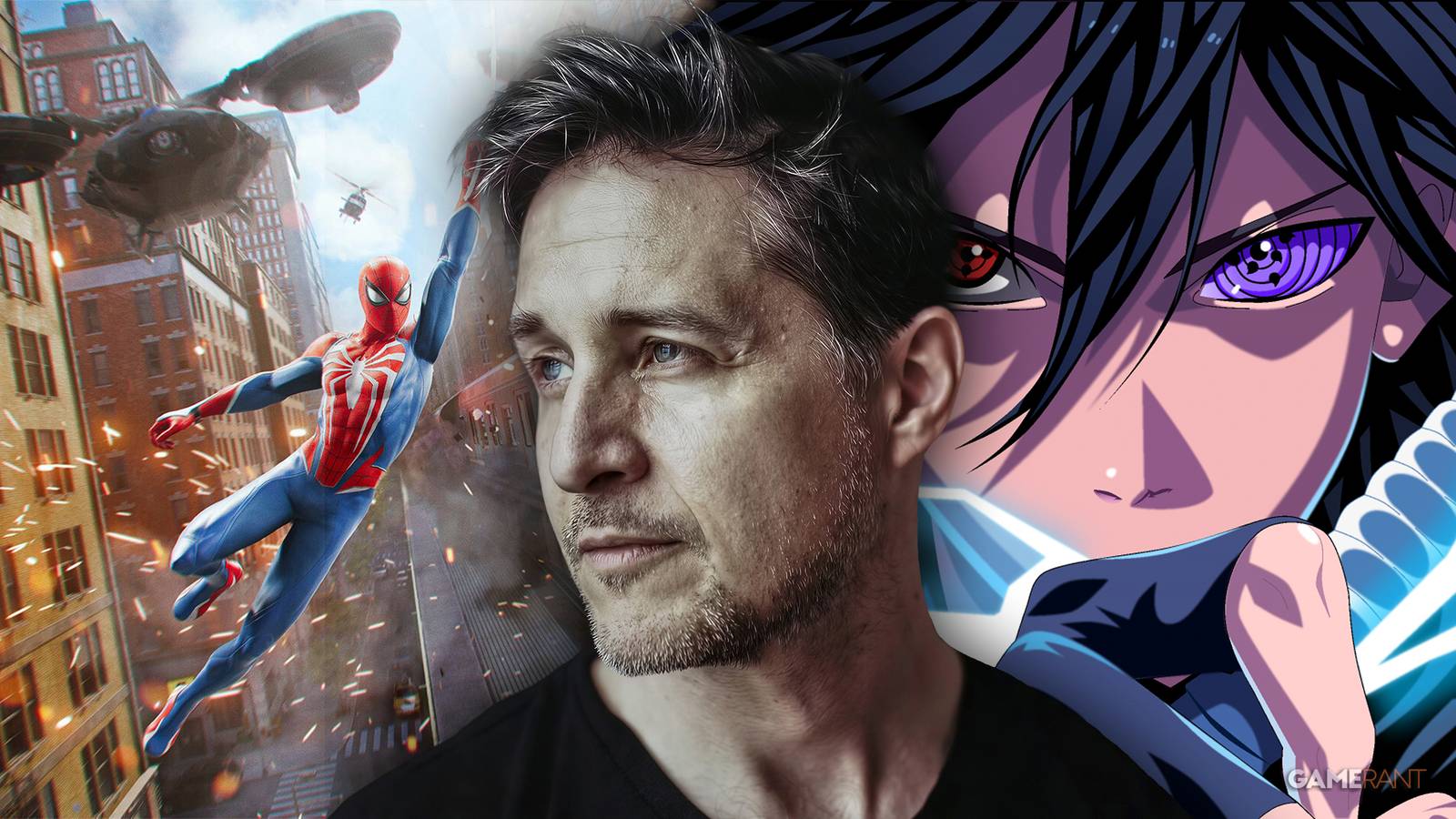
Yuri Lowenthal may be best known for bringing video game characters such as Marvel's Spider-Manis Peter Parker and Personas 3s protagonist to life, but unbeknownst to some, his career extends beyond the world of video games. With iconic roles like Narutois Sasuke Uchiha and Code Geass' Suzaku Kururugi adds to his resume, Lowenthal is a great example of an industry talent that has managed to bridge the gap between games and animation. Due to his tonal range, adaptability to directorial styles and willingness to reprise roles, the actor's repertoire continues to grow as his options are far from limited.
Marvel's Spider-Man 2Yuri Lowenthal isn't the only one who's managed to bridge that gap though, with actors like Troy Baker, Laura Bailey and Matthew Mercer all finding their way into the animation industry despite being largely recognized for characters they've voiced and acted for in some of gaming's biggest titles. Of course, much of this is down to the skill of actors like these, but the gaming industry has also changed over the past two decades in such a way that the gap between video games and animation is increasingly narrowing. As a result, actors who possess the talent level of someone like Yuri Lowenthal have an easier time infiltrating the world of anime—or even the other way around, if their careers began in animation and have since expanded into gaming.

New hint suggests Insomniac's Spider-Man 3 may already be in development
New information from one of the game's actors suggests that a new entry in Insomniac's Spider-Man series may already be in active development.
Bridging the ever-narrowing gap
At one time, animation and voice work in video games required two different things from actors. In animation, an actor's voice needed to be exaggerated and expressive, mainly because the performance itself is what defined a character's personality, tone, and energy. In fact, animators often built characters around their voices, matching the character's personality with the actor responsible for bringing them to life.
In games, on the other hand, voice acting hasn't always been treated as a necessity so much as a bonus. First, most of the earliest games didn't even have fully voiced characters, and if any did, it was extremely limited. But even when developers and publishers started paying actors to voice the characters in their games, for a long time, it was still an addition to text boxes and a host of other silent supporting characters and extras.
Actors possessing the talent level of someone like Yuri Lowenthal have an easier time infiltrating the anime world…
It wasn't until the late 90s that the gaming industry had what could be called a “cinematic breakthrough”, where video games began to feature full voice acting throughout their narratives. Games like Metal Gear Solid is a great example of this, and it's even widely considered to be one of the first games where the voice acting actually carried the story and the characters felt like actual appearances. Later, games like Final Fantasy 10 and The Elder Scrolls 4: Oblivion would develop this further, with the former featuring an entire cast of fully voiced characters and the latter featuring an entire world of characters with voices.
It's acting, not voice acting
Over time, voice acting in video games has evolved so significantly that it is now looked down upon to refer to these actors as “voice actors” rather than just “actors”. The reason is that their performances now require the same energy, expression and naturalistic delivery required of anyone doing animation or even film and TV work. While there are plenty of games still being made today that don't have voiced characters in any capacity, those that look more cinematic in their presentation are almost expected to do so, as it can feel awkward for a character that looks like a real person to only speak via text box.
Thus, technological advances in the gaming industry have narrowed the gap between video games and animation, giving actors like Yuri Lowenthal an opportunity to exist in both worlds. Well, that and the fact that actors like Lowenthal are incredibly talented and therefore valuable to both sides of the aisle. But a lot of that still depends on what video games are capable of today, and what developers and publishers are willing to do for realism and cinematic presentation.
Games have caught up to the strengths of animation
To put it simply, actors like Yuri Lowenthal can effectively contribute to both animation and video games as modern games look more like movies and TV than they historically ever have. But because they look the way they do—and because they're often given deep, emotional arcs—they demand a lot more from actors than their voices. This is where performance capture can come in handy, ultimately enabling more expressive, more compelling portrayals.
Lowenthal actually did performance capture for Marvel's Spider-Manand that's one of the reasons why many probably couldn't imagine hearing another voice come out of Peter Parker's mouth in a Spider-Man video games from now on. Because actors don't have to remain locked in a recording booth when using performance capture, they can better immerse themselves in the physical expression of their character and display more emotion than they might otherwise. If done well, these characters can ultimately feel inseparable from their voices, just as animation was long before gaming caught up.

Actors like Yuri Lowenthal have the kind of reach that both media require
But another phenomenon that begins to take place is when a voice like Yuri Lowenthal's is recognizable enough for fans of his to follow him in media, even if they follow him into something they may not have been interested in to begin with – like anime. Because Peter Parker is in it Marvel's Spider-Manfor example, may have had such an impact on a player's emotions, they may become more intrigued by his work outside of video games and, as a result, follow him into that space. Since fans now commonly associate a voice with a character's identity in video games, that same identity can be transferred to other media, drawing fans in.
Actors like Yuri Lowenthal can effectively contribute to both animation and video games as modern games look more like movies and TV than they historically ever have.
But again, it's not just that the gap between video game and animation acting has narrowed over the years as actors can occupy both spaces. These talents still need the kind of supply that can support both mediums, and Yuri Lowenthal is one of them. Sure, Lowenthal has an incredibly distinct voice that's a little easy to pick out in a crowd, but he's also proven himself over time as someone who can handle a variety of roles well.
He can move between dark, brooding intensity, light, energetic humor and grounded vulnerability, seemingly on a whim, making him a perfect candidate for various genres, roles and media. In other words, there's still a noticeable gap between the worlds of video games and animation that actors in both worlds have to deal with, even if that gap isn't as wide as it once was. Ultimately, this is what other talented actors like Matthew Mercer and Laura Bailey can do as well, and that's why they exist in different mediums.
That overlap has created a space where the same performance can exist across different mediums without having to be completely transformed. As gaming continues to lean into cinematic storytelling and animation maintains its performance-first identity, actors with the right range and adaptability are positioned to easily move between both. Yuri Lowenthal stands as one of the clearest examples of that shift, not because he's alone in doing it, but because his career reflects how natural that crossover has become. The gap may still exist in form, but in practice it is no longer something that limits where a performance can belong.



- Released
-
20 October 2023
- ESRB
-
T For Teens due to blood, drug references, mild language, violence
- Publisher
-
Sony Interactive Entertainment
