About three weeks ago, I shared my first impressions of Marathon. After about 15 hours with Bungie’s ambitious extraction shooter, I was very pleasantly surprised with the game. Marathon‘s gunplay and movement felt good, the faction system felt rewarding, and its presentation elevated it to heights the genre rarely gets to experience. But it wasn’t all smooth sailing.
The bulk of my Marathon first impressions piece discussed my initial difficulty getting to grips with the shooter’s core gameplay loop and overcoming its exceptionally steep learning curve. Though I believed the initial grind was worth the pain, I stated that it would be a major turn-off for many new players. After another 20 hours or so, my sentiments have stayed largely the same. But the more time I’ve spent with Marathon, the more I can safely say that the good heavily outweighs the bad.

Bungie Commits to Marathon’s Support ‘For the Long Haul’
Bungie reassures fans that it will continue to support Marathon for years to come as the developers roll out new updates to the shooter.
It’s a Marathon, Not a Sprint

By far the biggest hurdle in Marathon‘s path is still its incredibly steep learning curve and its intimidating first impression. While the game’s barebones tutorial does a fine job of teaching players the core mechanics of combat and loot scavenging, it does little to explain the gameplay context behind why players are actually using these mechanics, or what they’re working towards. As such, it’s very likely that a player’s first few matches are going to be filled with abrasive speed bumps that deny any real sense of substantial progression.
An average day-one match of Marathon will see new players thrust onto a surprisingly expansive map, filled with multi-level POIs and a plethora of interweaving pathways and dangerous open spaces packed with environmental hazards. On top of trying to navigate this large playspace for the first time, new players will also likely spend the majority of their first few Marathon matches standing awkwardly in front of an open container while they take the time needed to read the descriptions of the items inside, something that’s necessary in order to learn their value in the wider gameplay loop.
While standing there perusing a somewhat cumbersome menu, it’s extremely possible for newcomers to then be ambushed by enemies. Whether it’s hard-hitting AI opponents or a team of real-world players, that ambush is almost certainly going to result in the new player’s death, which in turn will see them lose any gear they entered the match with. That frustrating first impression is only made worse when playing those initial matches in solo queue, where players can’t rely on teammates to revive them, and it’s much easier to be overwhelmed by AI adversaries or be taken by surprise by an enemy Runner.
In its opening hours, Marathon feels like an unforgiving, frankly confusing mess of complex mechanics and unexplained systems, and its even greater emphasis on PvP than other genre contemporaries might make even the most seasoned extraction shooter fans feel a little out of their depth. But if you’re willing to push past those first few hours, which is an admittedly tall order in this age of gaming, Marathon becomes a truly engrossing experience that’s unlike anything else out there.
Nailing the Fundamentals

Even in its most infuriating and unstable opening moments, the core fundamentals of Marathon‘s gameplay feel solid as a rock. As should be expected from the studio behind Halo and Destiny, Marathon‘s gunplay feels incredibly satisfying right out of the gate. There are almost 30 weapons in Marathon‘s ever-growing arsenal, and while not all are equal in terms of efficacy, they all have distinctive visual designs, animations, sound effects, and game feel. Along with a vast array of unique weapons, Marathon also offers a plethora of attachments that give players a good deal of freedom to forge a build that suits their desired playstyle. These weapons and attachments go hand-in-hand with Marathon‘s class system.
Officially called “Runner Shells,” Marathon is home to seven classes, each of which comes with their own assortment of active and passive abilities. While these abilities rarely offer anything that hasn’t been seen before in the hero shooter genre, they’re all varied and all work exceptionally well in the context of Marathon‘s moment-to-moment gameplay. Take the Triage Shell, for instance. On the surface, Triage is a classic medic class whose two main abilities see him healing allies with a robotic companion and reviving allies with a ranged defibrillator. Those abilities have been present before in many multiplayer titles, but they’re tuned to near-perfection in Marathon, with the game’s severe lack of lootable healing items making Triage’s abilities always helpful.
What’s even more impressive is that these Runner Shells are arguably just as useful in teams as they are in solo queue. Triage’s revive ability may not be needed, but its offensive capabilities are surprisingly solid, and the class’ healing bot can mean all the difference in intense 1v1 player-vs-player battles. The same can be said for all of Marathon‘s roster, with each Shell having at least one or two abilities that are equally or occasionally even more useful in solo than in teams.
Over the Hump and Into the Home Stretch

With those strong fundamentals in place, Marathon is likely to do a solid job of convincing newcomers to push through the chaos for at least a few hours. But the thing that’s really going to keep players invested and see them over that initial hump is Marathon‘s Faction system. Over the course of several hours, players will be introduced to six futuristic factions: CyberAcme, Arachne, NuCaloric, Traxus, MIDA, and Sekiguchi.
These factions are the very heart of Marathon‘s gameplay loop, with each offering an assortment of missions that provide mostly useful rewards. While the objectives of these missions aren’t overly unique or interesting, with most boiling down to multi-stage fetch quests, they provide a narrative and gameplay backbone that the extraction shooter sorely needs. In Marathon‘s opening hours, these faction missions offer what a better tutorial should have, teaching newcomers what resources they should be hunting for and gradually introducing them to each map’s various POIs. These missions also go a long way to alleviate the overwhelming disappointment of losing your entire loadout, as many early missions can be completed without needing to exfil, allowing players to still progress in a meaningful way in spite of death. Even 30+ hours into Marathon, these missions still act as a tentative, very welcome guide that carefully peels back the layers of each map and mechanic one step at a time, continuing to steadily build the player’s confidence.
As well as being a guiding hand through Marathon‘s network of complicated mechanics and maps, these faction missions form the basis of a very strong progression system. Completing contracts for a faction will increase the player’s rank for that specific group, and achieving a new rank will reward the player with a treasure trove of faction-associated goodies that range from new weapons to helpful consumables. Though not all of these rewards will suit your playstyle, the unwanted gifts can at least be sold for credits that can then be used in the Armory to purchase gear ahead of a run. Each faction also has its own skill tree, where players can spend key resources and credits to unlock permanent upgrades to their Runner Shell stats, as well as earn unlocks in the Armory, allowing them to grab some free gear every 24 hours.
Marathon‘s Codex also offers some challenges for players to slowly work towards, many of which offer cosmetic rewards like Runner Shell skins or weapon charms.
With these faction missions incentivizing players to keep grinding away, the once seemingly impenetrable surface of Marathon begins to break away, and some of its less overt qualities begin to shine through. Despite what its first impression might suggest, Marathon is actually home to some very nice quality-of-life features, such as the ability to track salvage, which highlights the item automatically when looting and clearly marks its associated POIs on the map.
Doing Laps Around Tau Ceti
While Marathon‘s Faction system offers a tangible, clear form of progression, the game’s maps offer a more subtle, yet equally rewarding learning curve. There are currently four maps in Marathon, with more planned to arrive in the live-service game’s near future. As well as having varied environmental designs, each of these four maps offers a distinct spin on Marathon‘s core gameplay loop. Perimeter, the first map available to new players, features a careful mix of wide open spaces and tight corridors, paving the way for both intense close-quarters firefights and larger-scale multi-team battles. Dire Marsh puts more of an emphasis on verticality, with its multi-floor structures teaching patience and careful footing. Outpost ramps up AI quantity and difficulty while condensing its map size, leading to much riskier, but even more thrilling scenarios. And the newly added Cryo Archive is a fierce endgame challenge that features raid-like mechanics and the game’s most dangerous AI foes.
Though each subsequently unlocked map in Marathon does offer a greater challenge than the last, the great level of variety found in each one’s unique level design, environmental hazards, and weather effects ensures that they all remain highly replayable, regardless of how many hours the player has put in or what their current gear floor looks like.
A First-Class First-Party Game

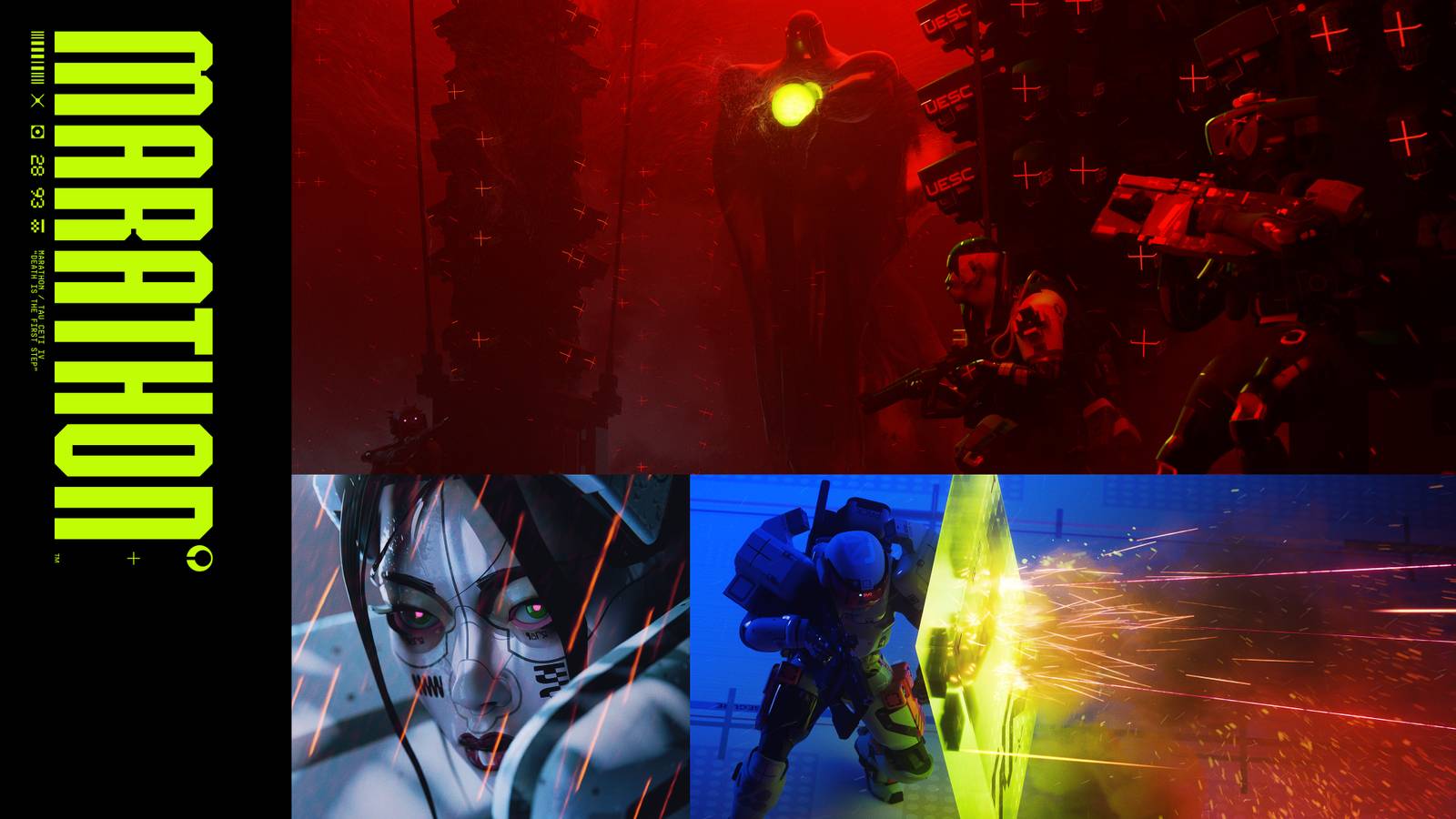
If there’s one thing Bungie fans can rely on, it’s the studio’s penchant for high production values, and Marathon is no exception. Put simply, Marathon‘s presentation is first-class. With a riveting blend of retrofuturistic technology, cyberpunk-inspired character designs, stark uses of vibrant colors, and almost STALKER-like supernatural elements, Marathon manages to bring the familiar together to create something wholly unique, which is no small feat in the Sci-Fi genre. This clear and expressive art style goes hand-in-hand with the game’s excellent world-building, with every aspect of the game’s visuals, from small environmental details to faction leader character designs, helping to paint a picture of the wider Marathon universe and the player’s place within it.
Marathon‘s sound design is also a standout component. Along with all the expected punchy Sci-Fi weapon effects and unnerving robot beeps and bloops, Marathon delivers a deeply unsettling score that seems to always come in at just the right time to heighten the tension of a match or add some unnecessary but very welcome gravitas to sorting out your Vault. Marathon‘s spatial audio is also top-notch, with footsteps and gunfire appearing exactly where they should in relation to the player’s position, even in the cheapest pair of earphones. The use of voice acting throughout a match and during faction debriefs is another clear sign of Marathon‘s first-rate presentation.
Much like Marathon‘s many gameplay systems, these overlapping presentation elements might feel a little off-putting or discordant at first, but their pieces will slowly fall into place, and they’ll eventually give way to an intoxicating atmosphere that’s unlike any other multiplayer game on the market right now.
At first glance, Marathon may seem like a fundamentally solid game with a lot of potential, but one that simply feels too intimidating to invest in. But if players are willing to jump over the unnecessary hurdles in Marathon‘s opening hours, they’ll likely discover that Marathon doesn’t just live up to its potential, but it exceeds it, with the current version offering a host of replayable maps, an engaging progression system, and a core loop that should keep extraction shooter fans coming back time and time again.

- Released
-
March 5, 2026
- ESRB
-
Teen / Animated Blood, Language, Violence, In-Game Purchases, Users Interact
- Multiplayer
-
Online Multiplayer, Online Co-Op
- Engaging and rewarding progression systems
- First-class visuals and sound design
- Satisfying gunplay
- Varied classes and build potential
- Memorable map design
- Incredibly steep learning curve
