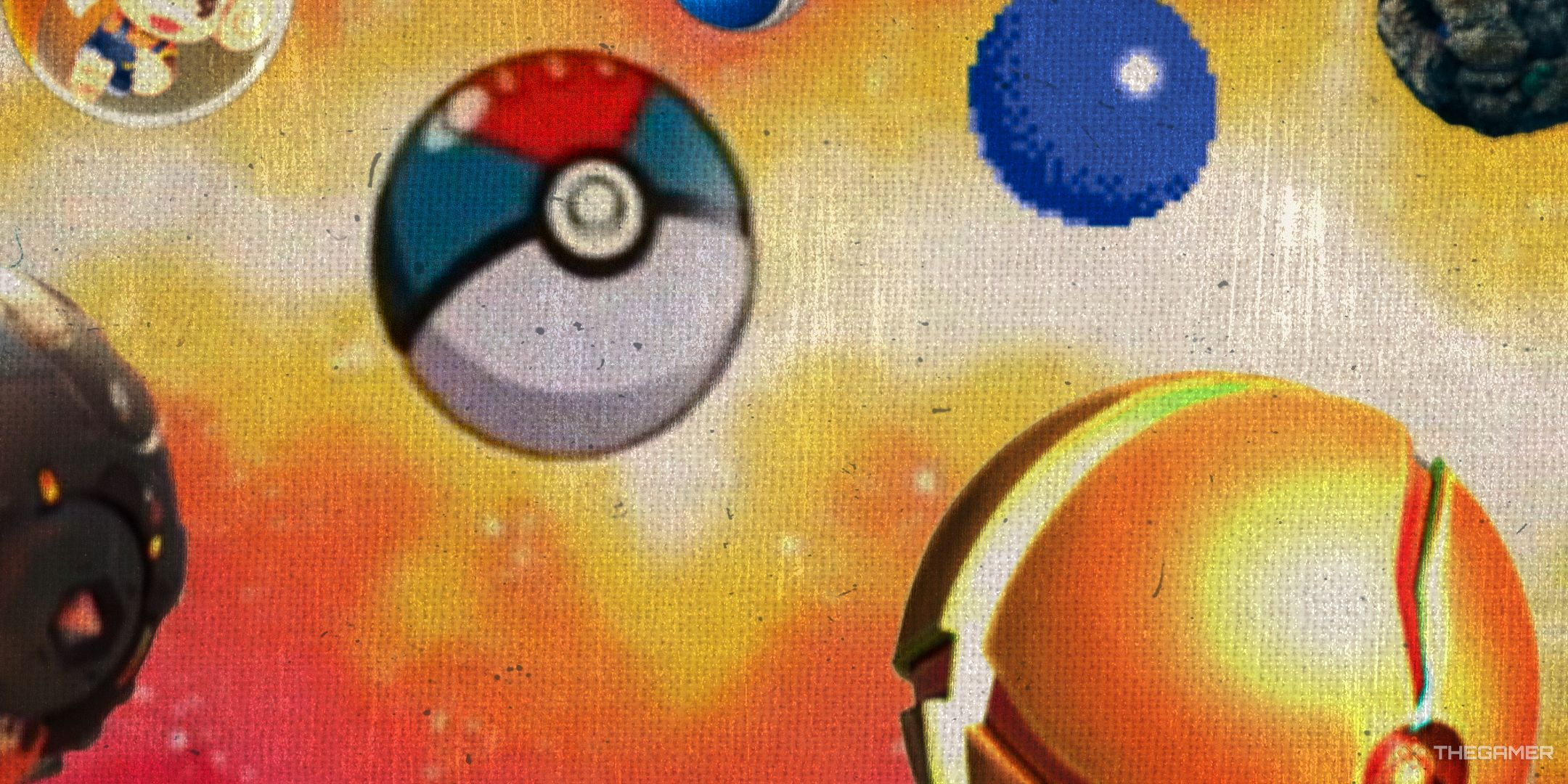
It's something infuriating that too many video games have in common. No, not the $70 price tag. No, not excessive violence and gore, that kind of stuff actually rocks. And also no to microtransactions. They don't rock, they're just not what I'm talking about right now. No, I'm talking about balls.
More specifically, characters that turn into balls. For decades we have dealt with the spherical phenomenon. It first reared its ugly head in the 1980s, and it shows no signs of slowing down.

Family
Pokemon Scarlet & Violet prove that fastballs are the goat
An ode to my favorite balls
Sonic The Ball Hog
I started thinking about this during a recent session with Sonic X Shadows Generations, the latest game in a series where almost every playable character can turn into a ball, spin like an engine and rush through loop-de-loops. Sonic, Shadow, Knuckles, Tails, Amy, Cream – they all seem to have hidden engines that power them as they transform into enemies like runaway cue balls. Sonic's transition to three dimensions made this even weirder, as the orb could now not only roll like a self-propelled tire, but also shoot through the sky like a homing missile looking for enemies. Do these characters have jet engines that I can't see?
Sonic is far from the only video game character who can defy the laws of anatomy to go into globe mode. Since the start of the Metroid series, Samus' Morph suit has allowed her to become legless, turn into a ball, and roll around. Samus is canonically 6'3″, but she can somehow shrink down to the size of a muskmelon and slip through cracks and crevices, effortlessly controlling her newly orb-shaped body with no apparent method of vision.

Of course, there is also Pokemon, which may be the most famous example of this phenomenon. In the games and anime, Pokémon are captured in balls that fit in the palm of your hand – regardless of the creature's size. Whether it's giant Gyrados or tiny Caterpie, one size seems to fit all. And what are they doing inside the ball? This isn't a new question – people have been exploring the understudied dark side of Pokemon for decades now – but I find it odd that even this fits the ball theme.
Pokémon appear to turn into energy at the moment of capture, as a flash of light accompanies their transmission. They can even become data, as the games allow you to store your extra monsters in a PC.
Sphere, there and everywhere
While these are some of the more obvious examples, video games continue to return to the spherical form factor. The Wrecking Ball in Overwatch 2 becomes the ball, and the power of this action is so powerful that the game switches to third person to allow it. Or, in Super Monkey Ball, the titular ball captures the monkey stars who are forced to complete ridiculous obstacle courses for their survival.
Then there is the other variant, where the character uses a ball as a tool. That's the case in Katamari Damacy, where the prince's protagonist rolls around a pile of trash, gathering more mass as it collects trash. In Billy Hatcher and the Giant Egg – from Yuji Naka, the infamous space devil who gave us Sonic – the title character rides around on the titular egg, using the egg as a vehicle.
What's with this form factor? Why do video games return to the realm again and again? Are developers like magicians, thinking about their orb? Or am I the sorcerer who has lost myself in the glassy depths of the orb?

Next
Where on earth are Metroid Prime 2 and 3 being remastered?
It would be nice to be able to play through the series on Switch before Metroid Prime 4: Beyond hits next year.
