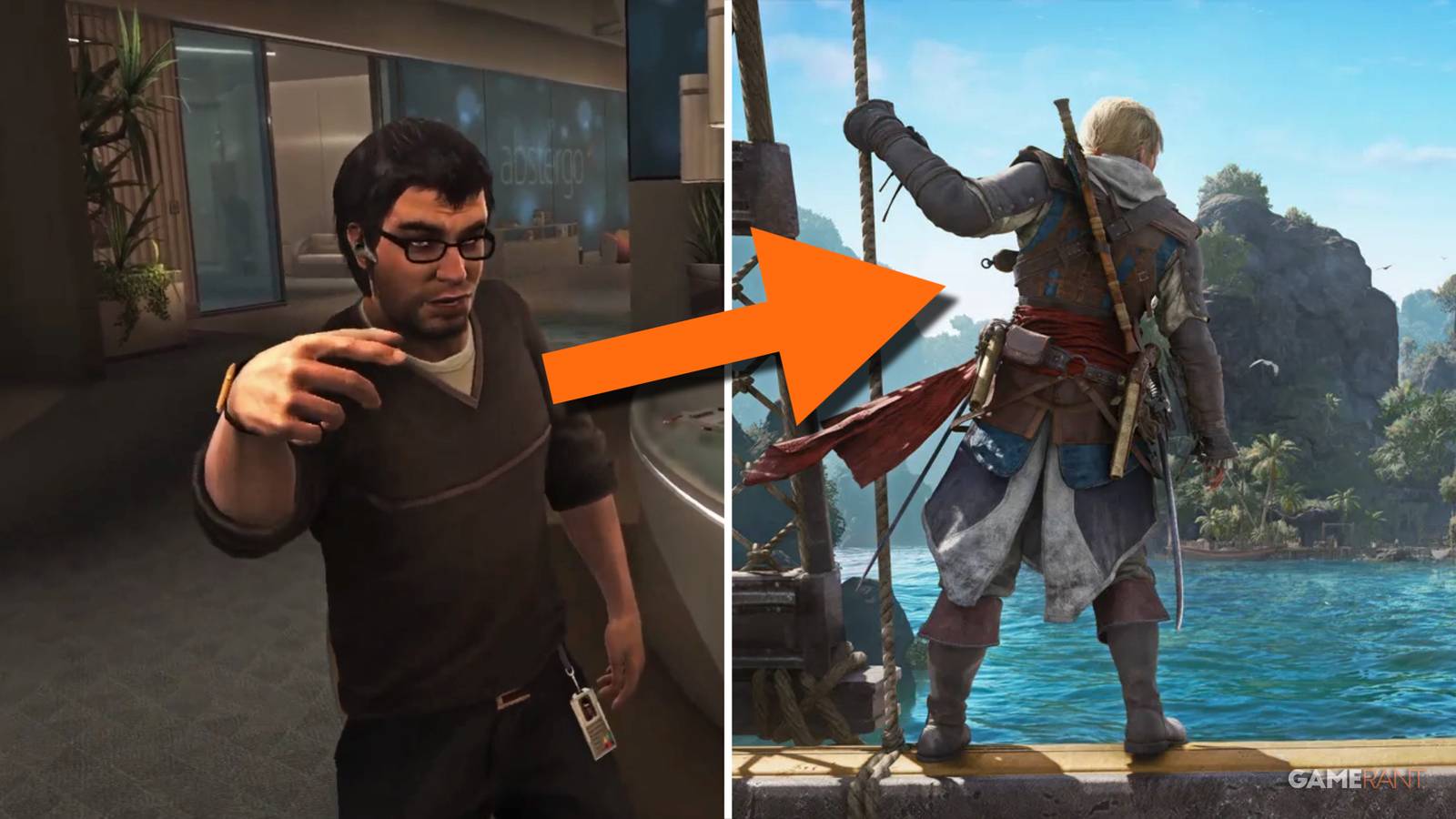
Assassin's Creed Black Flag resync is arguably the most ambitious remake in the franchise's long history – a ground-up rebuild of the beloved 2013 pirate epic using the same Anvil Engine technology that powered last year's Assassin's Creed Shadows. But beyond its visual and mechanical overhaul, the remake takes a bold turn on one of the most divisive aspects of the original game: its modern story. Instead of just updating what was there, Assassin's Creed Black Flag resync is to replace it with something darker, more thematically daring and probably more squarely centered on Edward Kenway himself.
Although the game is still some way off, a select group of press and content creators have now been given hands-on time with it AC Black Flag Resyncedincluding a bit involving the new modern content. What they've found looks less like a corporate conspiracy thriller and more like a short story about the psychological hold the Animus itself can have on a person. And even more than that, it looks like it might actually be a continuation of what was, a reframing of why someone in the future would want to be Edward Kenway in the first place.
The modern story of the original Black Flag and why it's gone
For context, the original Black flag was in the difficult position of picking up after the end of the Desmond saga, and as such it introduced one of what could have been one of the franchise's cleverest meta-narrative conceits: the player was not Desmond Miles, but a nameless new hire at Abstergo Entertainment, the consumer-facing arm of the Templar corporation. Tasked with extracting Edward Kenway's memories for a pirate-themed interactive movie, the player wanders an elegant Montreal office in first-person, snooping through emails and slowly uncovering the Templars' true agenda. It was a corporate satire to be sure, but dressed in those sci-fi espionage clothes and with a healthy dose of dramatic irony flowing through it, it had the makings to be compelling if executed well.
Whether that promising premise made it into the original is a matter of opinion, but game director Richard Knight has also been candid about why it would feel like a pain to recreate it in 2026. In an interview with GamesRadar+, Knight said, “Then it was very important to know what happened to Desmond's friends.” Creative director Paul Fu added that keeping the original Abstergo sequences would feel “shaking” to players who have come to the series through more recent titles – and Resynced needed to fit the current direction of the series, not fight against it.
Animus Rifts as “What if?” Stories
As such, Ubisoft Singapore has decided to develop Animus Rifts from Assassin's Creed Shadows to something more narratively focused. Fu described some of that distinction in a Game Informer interview:
“Edward's story is now told in modern rifts, which are now almost like secret bottles that you find in the Caribbean, so they don't telegraph and drive the story strongly anymore; you have to actively search for those secrets.”
With that in mind, it's clear that some of these secrets contain “What if?” scenarios — alternate versions of Edward's story and imagine different paths he could have taken. One specifically mentioned was “what if Edward chose greed over his wife?” But how exactly does that tie in with an unplayable modern story that's meant to be “a little more narrative-driven” than what Shadows offered appears to be a more convoluted premise.
A modern story that actually stops at Edward

How the character Edward Kenway serves as the narrative link between these scenarios and a continuing modern story is Knight, who explains from a developer's point of view: “We wanted something that could still be that experience but also tie it back to Edward, and that's where the 'What Ifs' are important.” That said, the real clarity in this case comes from a disclosure from the content creation circle, it becomes a little clearer how Resynced treats these two elements as the same story seen from different angles.
What early access has revealed
While they can't be shown here, screenshots and content from early access players have provided the first real look at how the new modern material is actually structured. An “encrypted blog post” visible in the interface has a timestamp of 2096, placing this version of the present approximately 83 years after the original's 2013 setting. The Logs paint a picture of a corporate dystopia: tranquil populations, “pacified countries,” Abstergo partnerships with authoritarian regimes, and a society that has traded political agency for consumer comfort—less the tech-savvy corporate satire of the original, more a fully realized cyberpunk setting where the Animus has evolved into mass-market infrastructure.
Something called “the Dark” is mentioned, and it seems to be a reference to the Animus itself as an immersive digital environment people disappear into after long days in a bleak reality. Rather than the old Animus chair in a research lab, this version sounds like something people compulsively plug into, addictive in its design and transformative in ways that might not be entirely healthy.
Who is that character?

Identify the silhouettes before time runs out.
Start
Identify the silhouettes before time runs out.
Easy (7.5s) Medium (5.0s) Hard (2.5s) Permadeath (2.5s)
Identity Bleeding and Behavioral Transfer
The screenshots show lines like “Edward Kenway makes a name for himself across the Caribbean, and I'm the one who pulls the trigger” and “His swagger becomes mine” to describe the as-yet-unnamed narrator actively taking on Edward's identity – his confidence, his defiance of authority, and his refusal to submit to systems bigger than himself. How this interacts and mixes with any “What If” scenario is still very much a mystery, but the behavior transfer is certainly centered on Kenway, and the darker tone shift shown is certainly promising, at least.
A potentially new way of thinking about the modern story

All of this information may seem a little disjointed now, given that the game's actual release is still some way off on June 9th, but it's nice to know that, at least from a premise perspective, the building blocks for a great modern story are there. And while Fu acknowledged that the original modern story has its fans — himself included — it's clear that rather than shoehorning the 2013 story back in, the team has rewritten parts of the story to allude to it, if not directly after it. In particular, Fu hinted at a new scene with Bartholomew Roberts that will “pull at the heartstrings” of longtime fans.
Ultimately, the early evidence suggests that, along with all the other new content coming along Resynced, Ubisoft is actually repeating the previous modern story with something that has the potential to redefine what this layer of the franchise is for. Right now it looks like less exposition, less conspiracy posturing and a lot more psychological atmosphere. Frankly, it doesn't seem like a terrible idea, especially if the 2096 timeline holds. If the huge pivot can actually resonate, Assassin's Creed Black Flag resync could be the post that finally makes the franchise present a place worth caring about.

- Released
-
9 July 2026
- ESRB
-
Mature 17+ / Blood, Sexual Themes, Strong Language, Use of Alcohol, Violence / In-Game Purchases, User Interaction
