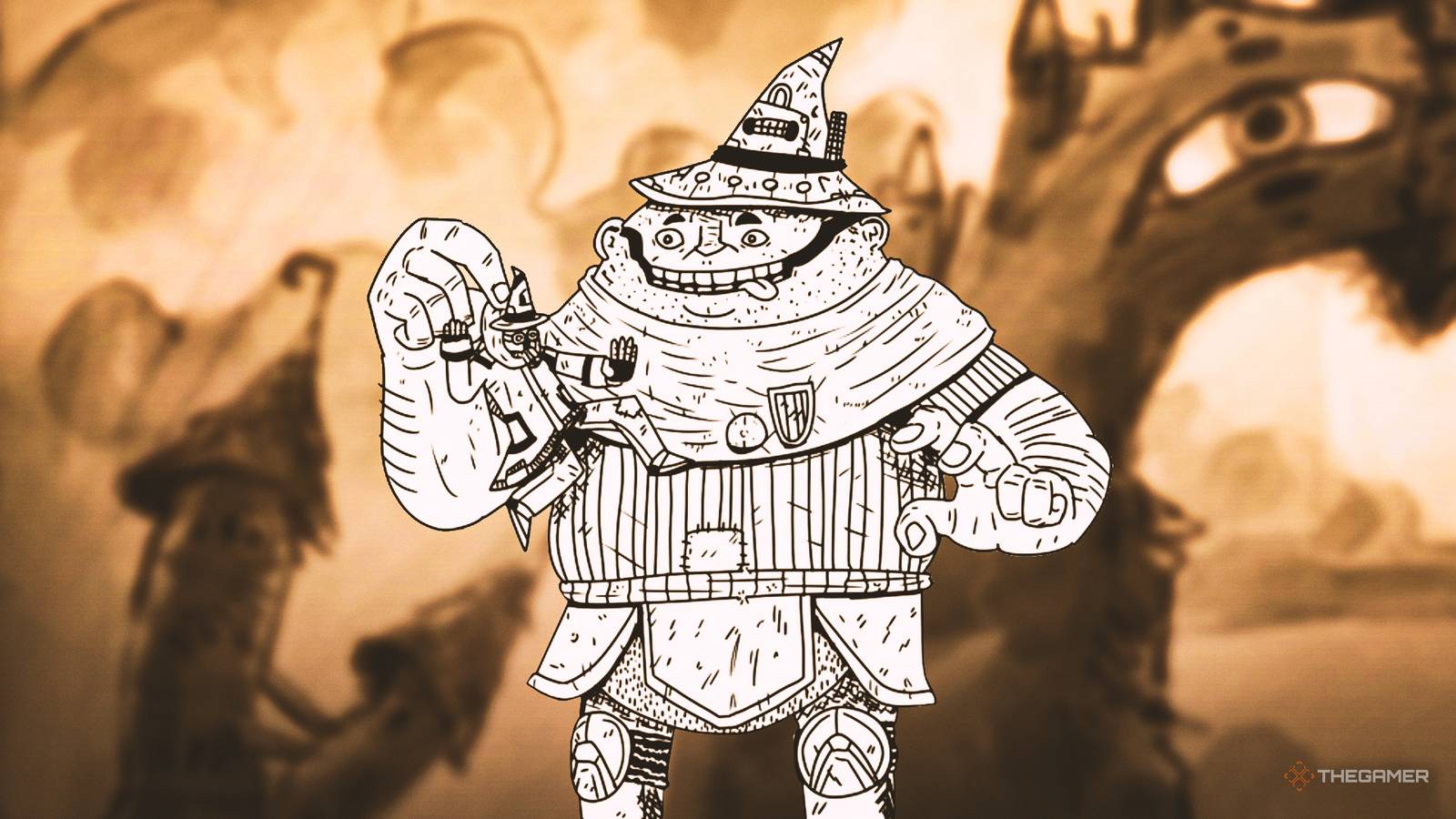
Imagine Terry Pratchett writing All Quiet on the Western Front. Now turn it into a Turnip28 inspired war game. And voila. You've got Aetherpunk28, a tabletop skirmish game with dwindling magic supply but bursting with personality. Think Warhammer, but narrative. Kill Team, but fun. Dungeons & Dragons, but with trench warfare. Any game where you can choose from 55 different 3D printable hats is already a winner in my eyes, but there's something extra special about Aetherpunk.
Maybe it's because I'm burnt out on 2000pt Warhammer battles, maybe creator Jack Edward's exuberant energy stuck with me when we played through an intro battle at Fringe Fest last month. Perhaps it's because the satirical world-building of its World War I fantasy setting seems tailor-made for my exact sense of humor—though who wouldn't laugh at Haggerland, the one setting where wizards have discovered that magic is a rapidly depleting fossil fuel? I caught up with Edwards via video call to tell me about his first narrative approach to game design, his 5,000 percent funded Kickstarter, and to find out exactly what has drawn me, and so many others, into the world of Aetherpunk28.
Edwards says he's always “tinkered” with games and rules, bending his early Warhammer battles to better reflect the lore before he found 28Mag and discovered a whole new world of independent, narrative wargaming. He launched himself in Turnip28, where “the emphasis was not on the game, it was on the story.” But Aetherpunk had already caved for a while by this point.
Aetherpunk28's surprising beginnings

“Aetherpunk started as a novel,” he tells me. With a degree in creative writing and years of experience writing novels and as an editor, it seemed like the natural starting point. When you take his experience into account, Aetherpunk28's narrative gameplay starts to make a lot more sense.
“Everything starts as a story first and then it evolves into mechanics, into different styles and units,” Edwards explains. That world-building – and thus the gameplay – is built by simply asking questions. “What I've taken from novel writing is that you have to have answers to all questions,” he says. “Whether you share them with the audience or not is entirely up to you.”
An interesting example is his view of golems, which come primarily from Jewish folklore. “How would a group of wizards dedicated to animating things – obviously their key unit will be a golem – use that device? Are they a tool? Are they someone with equal rights, as has slowly become the case over time? I owe most of it to 'Pandyman Paints', who at one of the Aetherpunk events brought a 'golem' now they are starting the Golem Union. So due to a community suggestion, the Golem Union is now in the game.”

Aetherpunk feels like it has been shaped by the community that has supported it. What started as a fun way for Edwards to play something new with his friends and use his polyhedral dice often became something of a phenomenon on the indie wargaming scene. Aetherfest tournaments take place several times a year, players go all out and convert their wizard bands, and many of their ideas make the rounds and are implemented into the game itself.
“I try to make sure there are gaps for people to fill in and [room for] other interpretations of things,” says Edwards. “That's really important, especially in an indie game with a community that's so creative and imaginative. If I say all wizards look like this, you've instantly lost about half your audience and you're killing creativity.”
Edwards will never shoot down a player's idea because it doesn't fit the story. From time-traveling dinosaur-riding wizards to a force made entirely of frogs with hats, gamers have really pushed the boat out. What is less common, however, is that Edwards often incorporates these ideas into official supplements. But to really sow the seeds of that creativity, he built the game to fit the emerging stories players wanted to tell.
Create a narrative-first wargame
It's not enough to build a brilliant world and then put a competitive, meta-based game into it. Edwards was committed to ensuring that every unit and mechanic embodied his core principle of telling a story, either through his handcrafted lore or a player's custom miniatures.
Take shelter for example. Instead of using a modifier if you can see 50 percent of the miniature, as is common in Warhammer, Aetherpunk measures with the base. If more than half the base is covered, you get the defensive buff. It may seem like a small change, but this allows players to build their butterfly cavalry on 12” tall flying trunks, for example, or replace their warlock with a toad and not be accused of “modeling for advantage”.
Even the 3D printable miniatures — designed by longtime collaborator Hannah Giesen and French husband-and-wife duo Vae Victis — are “to make the game accessible” rather than to make money, Edwards explains. Right from the army building stage, or when you physically assemble the plastic pieces that make up your pretend wizard, the point is to tell a story. The rules also follow the same design ethos of committed ludonarrative resonance.
Trench Crusade's new plastic starter set was a “giant gamble,” says creator Tuomas Pirinen
Trench Crusade has revealed The Carcass Front, a new starter set and narrative campaign box, at Adepticon.
“All the mechanics came from the story I was trying to tell,” Edwards explains. “I was trying to tell the story of a resource war and sell the idea that everyone is a mage so everything feeds into that – any decision about wargear or units. The way the magic system works, where you get magic and you spend magic, but you always spend it faster than you win it, that was done to convey the story. And the rulebook itself is also buildable as an artifact immersion.”
The magic system involves you collecting Erudite Charges each turn, which can be used to power up your models or cast or disconnect spells. But what I find more interesting are the statistics. Each unit is equipped with four main stats, plus movement speed and a range for their weapons. However, the Ranged, Melee, Defense and Willpower stats are represented by your polyhedrals and can change during gameplay.
Your bog standard Slogger, for example, has a melee stat of d6. A Scrapper, armed with a trusty spade or club, will hit with 3d8 instead. Hitting, wounding, saving is all easy: you have to hit a 6 or higher. But when you factor in special rules and powers that modify those baseline dice rolls, a Scrapper that hits you with 3d10 damage is probably going to leave you sore.
Putting the punk in Aetherpunk
While the core rules will always be available for free, Aetherpunk28's second and final edition raised almost £13,000 of its £250 target throughout its crowdfunding period. The rulebook inevitably grew, filled with lavish stretch goals and even, for some backs, their own magical colleges included in the game. “Sure people like wizards and World War I,” laughs Edwards, but he wanted to “give something back” to the community by adding their work to the official release.
There is so much about Aetherpunk that I haven't even discussed here. The setting's wizards live in literal ivory towers (“subtlety is for cowards,” says Edwards) while their apprentices suffer in the trenches. Pratchettian humor is liberally sprinkled throughout the rulebook. Edward's customers get to choose which part of the world they explore in his next campaign. The game itself is layered with ludonarrative resonance, like the polyhedral dice that represent a variety of oddly shaped Erudite crystals.
When it comes to following in his footsteps and making your own game, Edwards has some sage advice. He recommends playing the holy trifecta of indie wargames: Tonks, Turnip28, and Necropolis. But above all, he says, just write the thing. “Just write the game, test the game and throw it at people,” he says. “There's a real concern that things have to be perfect when you first write them and that's not true. Make a crappy game and then make it better afterwards.”
Alien Vs Praetor: My Quest To Make The Perfect Xenomorph Versus Romans Game
For Alien Day 2026, I set myself a challenge to create the game of my dreams.
