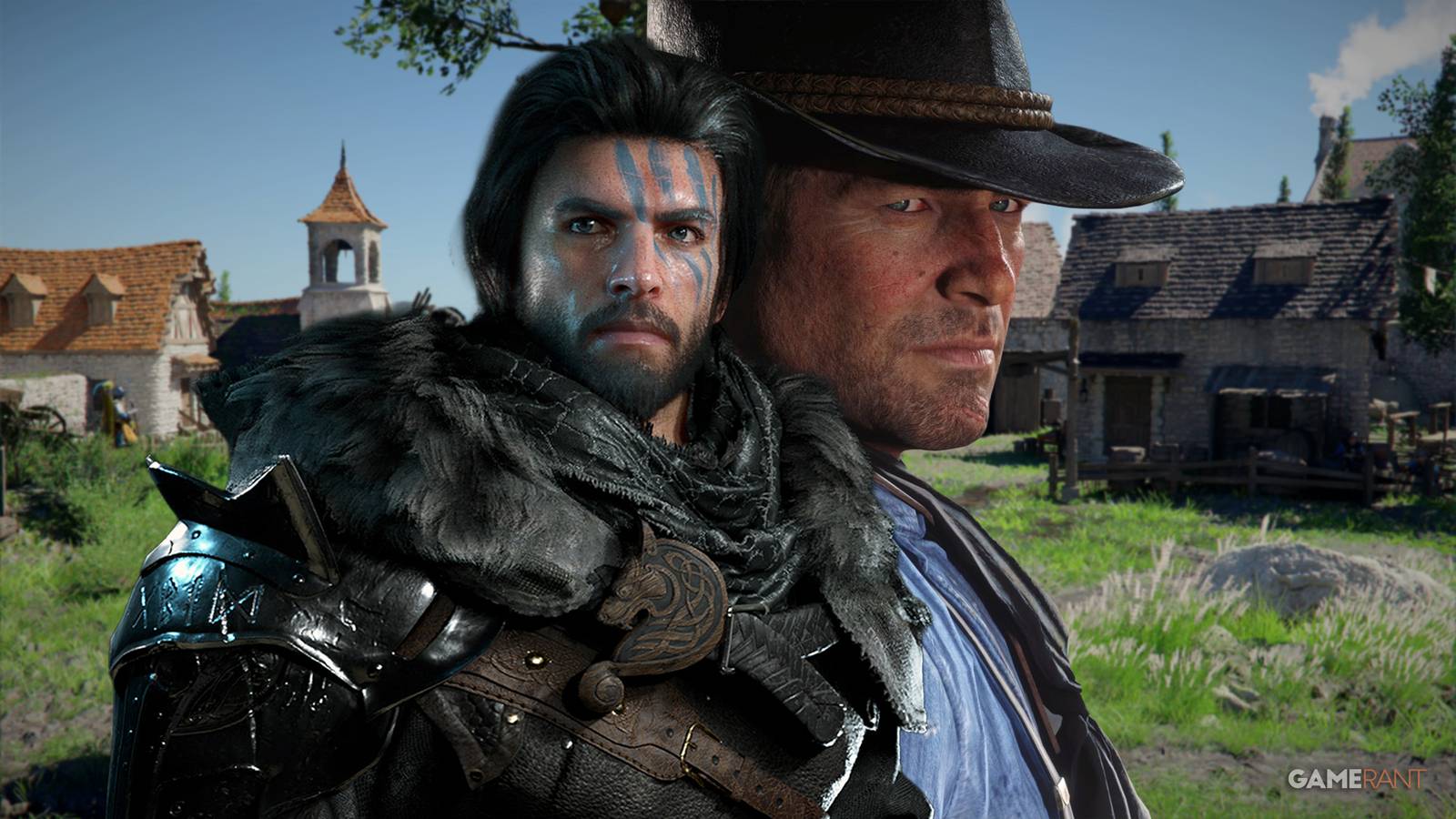
Since its launch, Red Dead Redemption 2 has been considered something of a standard for realism in the gaming industry, with fans regularly posting clips online showing how even the normal behavior of the game's NPCs is translated into something that looks authentic. An NPC eating a plate of food, for example, may actually consume that food, with the plate becoming increasingly empty with each bite. Another NPC might be sawing a wooden board into pieces, where each part is clearly separated from the rest. Red Dead Redemption 2 was clearly meant to be a world that players could live in that would feel believable and real, even if they don't notice half of it as they trot through town on the back of their horse. However, Crimson Desert has now come along with its own take on realism, and while it's different than what RDR2 does, it still poses a challenge.
Yes, Crimson Desert has jetpacks and dragons, and to some the idea that it has a realistic world might sound like nonsense because of that. But realism is much more nuanced than the content of a game's world. Yes, Red Dead Redemption 2 can feel real because it grounds its believability in the everyday, with every animation and interaction designed to mirror real life as closely as possible. However, Crimson Desert approaches realism from a completely different angle, making it something that is not just seen, but actively discovered and experienced. That doesn't make it less realistic, just realistic in a different way.

Crimson Desert Review: A Remarkable Open World That Often Asks Too Much
Crimson Desert offers one of the most impressive worlds in gaming, but the deeper you go, the more it begs you to face it on its own terms.
What video game realism is and isn't
Realism in games is often mistaken for accuracy, but the two are not always the same. A game doesn't have to mirror real life perfectly to feel real. What matters more is consistency, credibility and how well the world holds together under scrutiny. When characters behave in a way that makes sense, when environments react in expected ways, and when small details enhance the illusion, players begin to accept the world as something that feels real, even if it doesn't resemble true reality. Realism, in that sense, is less about recreating the real world and more about convincing the player that what they are experiencing can exist within the rules the game has set.
Who is that character?

Identify the silhouettes before time runs out.
Start
Identify the silhouettes before time runs out.
Easy (7.5s) Medium (5.0s) Hard (2.5s) Permadeath (2.5s)
At the same time, realism is not about limiting what a game can be. Fantasy, exaggeration and even absurdity can still feel authentic if they follow a clear internal logic. A world with dragons or impossible technology can still feel real if it responds to the player in a way that is consistent and intuitive. Where games tend to break that illusion is when interactions feel arbitrary or limited in ways that clash with what the world suggests is possible. Realism, then, is defined not by how closely a game resembles real life, but by how naturally it allows players to engage with and understand the world in front of them.
Red Dead Redemption 2's realistic world still bends the rules
If realism is really about how much a game resembles the real world, then count Red Dead Redemption 2 out. It's not possible to slow down time in real life with something like Dead Eye, locking onto multiple targets and then automatically unleashing perfect shots at those targets. It's not possible to get shot multiple times and then eat some preserves or a tonic to be back to full strength in seconds. It's not possible to carry as much as Arthur does, with his inventory holding dozens of weapons, piles of animal hides, tonics, food, and valuables all at once without affecting his movement greatly. Even its law enforcement and crime system is sometimes not realistic, with witnesses able to identify crimes at odd distances and lawmen appearing surprisingly quickly in remote areas.
Why are those things allowed to exist while Red Dead Redemption 2 is labeled “realistic”? Because without them it wouldn't be a game. It would be tedious, boring and, more than likely, frustrating. To keep players entertained, developers have to bend the rules at some point, even in a world that is otherwise incredibly detailed. The key is knowing where to draw that line. IN Red Dead Redemption 2these concessions rarely clash with the rest of the experience as they support the player rather than break the illusion. They smooth out the friction that real life would introduce, while everything around them continues to reinforce the sense that the world is alive and believable. That balance is what makes the game feel realistic without actually being tied to reality.
The world of Crimson Desert has something that Red Dead Redemption 2 doesn't
That is ultimately where the argument that Crimson Desert challenges Red Dead Redemption 2s idea of realism has a foothold. RDR2s sense of realism is about visual details and animations, presenting itself as a world that feels like people actually live in. Basically, it's about selling the illusion of authenticity through realistic animations, interaction speed, and intentionally slowing down the player. Crimson Deserton the other hand – even though it has incredible visuals, believable animations and it does everything it can to slow down the pace of players – it manifests its realism in the way players interact with it.
While Red Dead Redemption 2realism is more of a background, Crimson DesertIt's about something players can actually get their hands on and experiment with. Almost every building in the game can be entered, almost every tree in the game can be cut down, and almost every visible location can be visited. Players can climb structures that most games wouldn't allow them to, enter spaces that seem merely decorative, and even speak and build a relationship with every single NPC in the game. That difference gives Crimson Desert one leg up on Red Dead Redemption 2making its version of realism less about how closely it mirrors real life and more about how convincingly it reacts to players.
If realism is really about how much a game resembles the real world, then count Red Dead Redemption 2 out.
If the players see a bucket in Crimson Desertthey can probably pick it up. If there is a cow roaming in a nearby pasture, they can run up to it and ride it if they want. If there is a closed window on a building, they can most likely open it to enter that building unseen. If there's a pedestal they need to rotate that doesn't have a handle, they can even stick their sword into it and use it as a handle instead. Ironically, it does Crimson Desert feels more like real life, as all these things are theoretically possible in the real world – although riding random cows is not recommended.
So, Crimson Desert may not be replaced Red Dead Redemption 2 as a benchmark for realism, but it shows that there is more than one way to achieve it. One creates a sense of realism through meticulous detail and true-to-life behavior, while the other is more about player freedom and a world that responds in believable ways. Both approaches work, just in different ways. Still, Crimson Deserts approach stands out because it consistently rewards curiosity, giving players the sense that the world is not just there to be looked at, but actually interacted with as one would the real world.

- Released
-
March 19, 2026
- ESRB
-
Mature 17+ / Blood, drug reference, intense violence, strong language
- Developer
-
Pearl Abyss
- Publisher
-
Pearl Abyss
