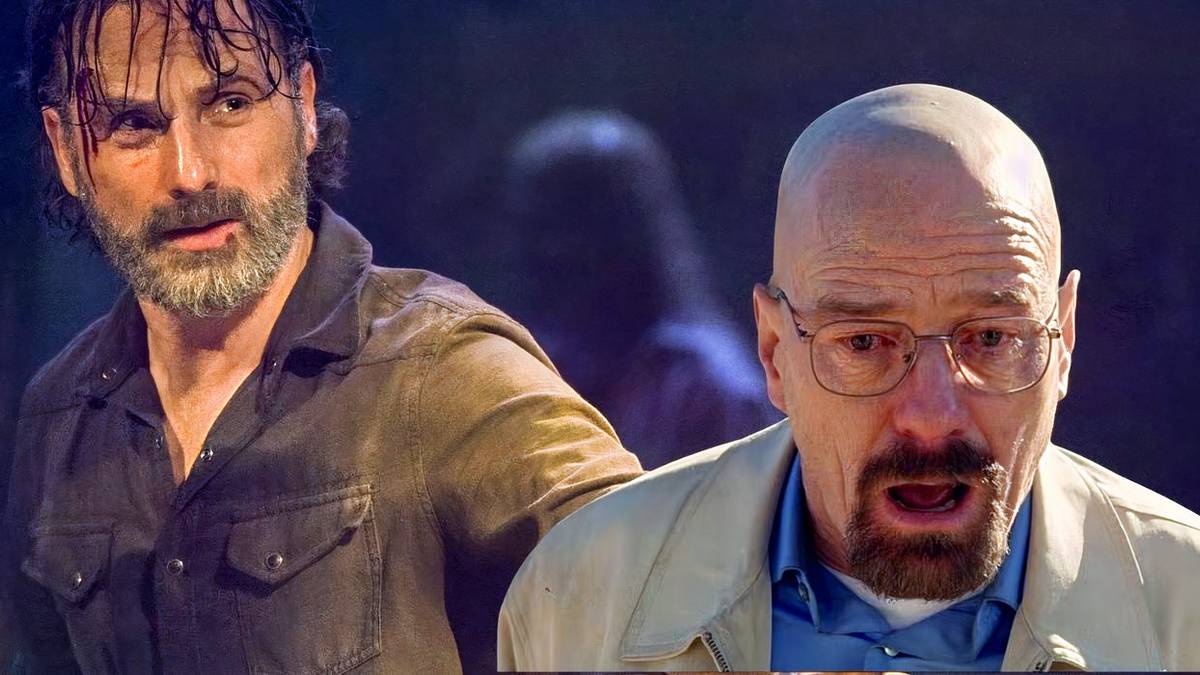
Some of TV's most impressive villains don't begin the series as antagonists. They start out as heroes and eventually evolve into cold, calculating or ruthless villains, completely transforming their arc and the show around them. Whether driven by ambition, desperation, or trauma, these once-heroic characters become far more compelling as they turn to the dark side, raising the stakes and providing some of the most dramatic episodes of their respective TV shows.
Between perfectly good characters turning villainous, morally ambiguous anti-heroes who completely lose faith, and shocking reveals that a character was evil all along, each character's turn proved that a well-executed fall from grace can be just as interesting as a traditional hero's journey. Some do it much better than others.
6 TV shows that became masterpieces after weak starts
It's common for a TV show to go downhill, but several others became 10/10 masterpieces after shaky starts, like The Office and Star Trek: TNG.
5
Grant Ward's Reveal Transformed Agents of SHIELD

Grant Ward didn't just become a villain in Agents of SHIELD; he was always one, but he hid behind a carefully crafted persona. At first, Ward was the team's charming and reliable combat specialist who never bent the rules and seemed to be the exact type of heroic operative that every spy team needs. His heroic introduction was pretty stale and didn't set him apart from much of the cast, but the Season 1 HYDRA Rebellion revealed that he was a HYDRA agent deeply embedded in SHIELD who had been secretly working for John Garrett all along. The Agents of SHIELD reveal shocked fans and recontextualized everything they thought they knew.
Ward becomes compelling only when his true loyalties are revealed. Agents of SHIELD explores his brutal upbringing, physical abuse, twisted loyalty to Garrett and obsession with Daisy Johnson. His actions become increasingly dark, from murdering Agent 33 to aligning with the alien Hive, while his personal connection to Coulson's team makes every confrontation emotionally charged. The revelation turned Ward from one of the Agents of S.H.I.E.L.D.s least distinctive heroes to its biggest recurring villain.
4
Rick Grimes became increasingly villainous in The Walking Dead
When The Walking Dead begins, idealistic Sheriff Rick Grimes is one of the many victims of the apocalypse, desperate to protect his family and preserve some sense of civilization after the zombie outbreak. For several seasons, he consistently tries to find peaceful solutions, and he often gave dangerous enemies a second chance. But by the time Rick reaches Alexandria, he has become increasingly villainous, often willing to execute without hesitation, threaten innocent communities, and adopt ruthless tactics during conflicts with the Saviors and other surviving groups in The Walking Dead.
Although Rick never becomes a full-fledged villain in the traditional sense, his interactions with The Governor, the cannibals of Terminus, and the Claimers forced him into a “hunt or be hunted” mentality, and he no longer believed that people could work together for the greater good. The Walking Dead repeatedly questions whether Rick has become the exact type of leader he once opposed, especially as he struggles to justify some of his more violent choices. His morally ambiguous turn gives the show much more depth than his straight victim/hero storyline in previous seasons.
The Walking Dead: 22 Best Villains, Ranked
The Walking Dead had many memorable villains, but some proved to be much more menacing than others; here are the best.
3
Faith's Dark Turn is a highlight of Buffy the Vampire Slayer Season 6

Faith arrives in season 3 of Buffy the Vampire Slayer as the new Slayer after Kendra's death. More impulsive and ruthless than Buffy, Faith initially serves as Buffy's rival but quickly becomes a valued ally. Still, her troubled upbringing and growing resentment leave her vulnerable to manipulation, and the downward spiral begins when she accidentally kills Vice Mayor Finch in Season 3. From there, she embraces increasingly violent methods before finally teaming up with Mayor Richard Wilkins, one of the deadliest villains in Buffy.
Faith's villain arc is where the character really comes to life. Instead of just turning evil overnight, Buffy explores her guilt, insecurities and desperate need for acceptance, making all her bad choices tragically believable. Episodes like “Enemies” and “Graduation Day” reveal a deeply conflicted antagonist, and her moral collapse transformed her from a fun supporting character into one of Buffy's best numbers.
2
Saul Goodman's journey in Better Call Saul is fascinating

Jimmy McGill starts Best to call Saul as a struggling lawyer desperate to prove himself. He is consistently cunning and willing to bend the rules in his early appearances, but he really wants to earn respect as a lawyer, and he often shows a remarkable kindness. But over six seasons, repeated betrayals, personal tragedy and his own worst instincts gradually force him to become Saul Goodman, the ethically bankrupt criminal lawyer seen in Breaking Bad.
Jimmy never becomes an outright villain, but watching his turn to Saul Goodman is infinitely more interesting than his early attempts to play by the rules. Over time, his ever-growing disadvantages, willingness to manipulate others, and eventual partnerships with cartel figures prove him capable of enabling some horrific crimes. Rather than a dramatic turn, Best to call Saul gives Jimmy a moral decline that ensures he's far more interesting as Saul than he was as Jimmy.
Better Call Saul: Biggest Mistakes Made By The Characters
Much like Breaking Bad, the drama in Better Call Saul is driven predominantly by bad choices made by the characters. Here are their biggest mistakes.
1
Walter White is Breaking Bad's ultimate villain

Walter White's character arc is one of the best in television history. Beginning as a chemistry teacher recently diagnosed with stage three lung cancer, Walter White teams up with his former student to start cooking and selling meth so he can leave his family money after his inevitable death. Breaking Bad fans initially sympathize with his plight, but as his criminal empire expands, Walter White becomes increasingly ruthless, selfish, and evil. Under the alias Heisenberg, Walter manipulated Jesse, poisoned a child, ordered assassinations, and eliminated anyone who threatened his power.
In the end, it becomes clear that Walter did everything for his own gratification because he loved the power and control his crime gave him. Of 'Breaking Bad'In recent seasons, he's evolved from his own story's hero to its primary antagonist, forcing audiences to confront the uncomfortable reality that they'd been rooting for a monster in the making. Not only did this character arc make Walter White even more compelling, but it also solidified it Breaking Bad as one of the best TV dramas of all time.
