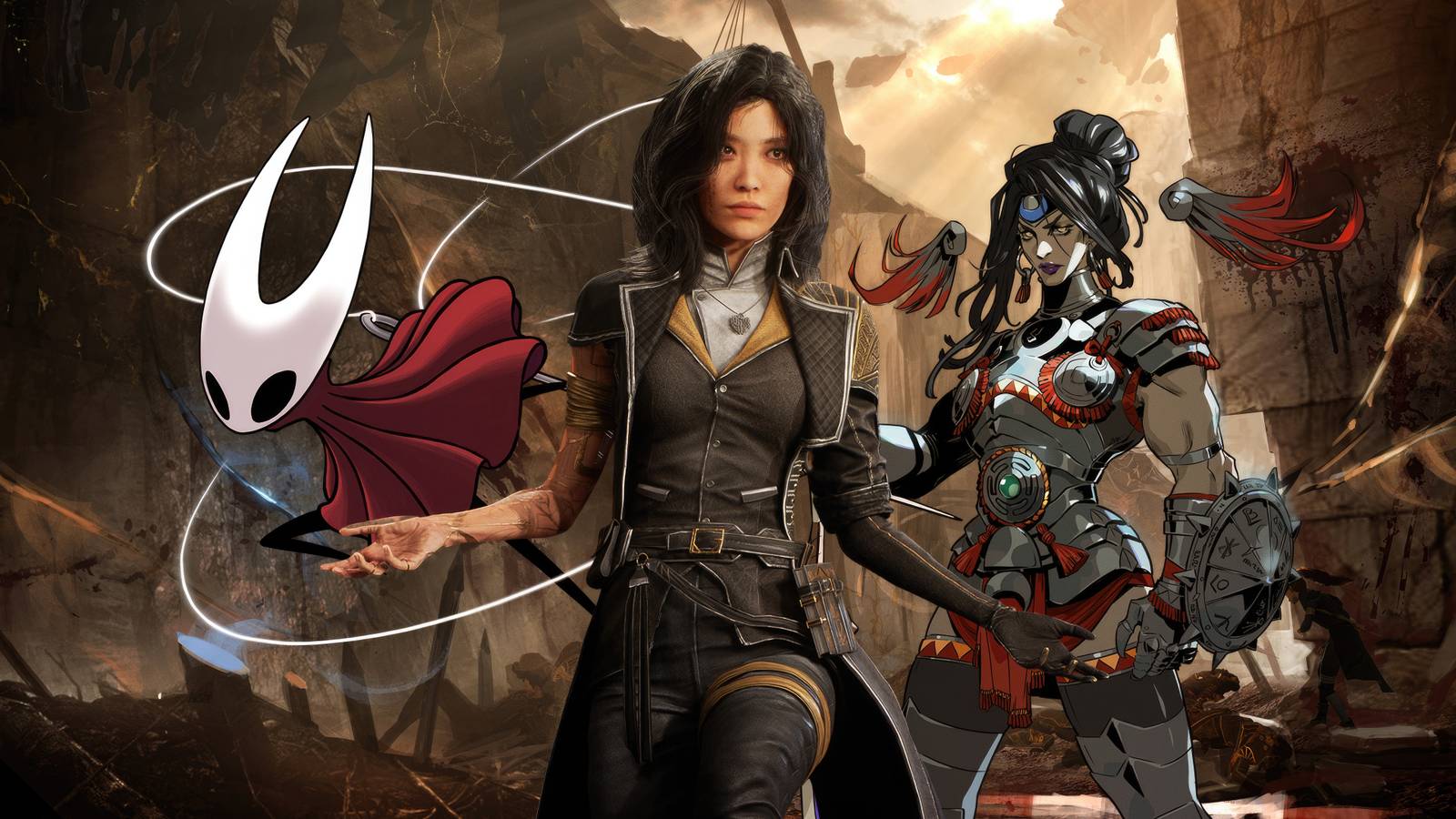
This year's Game Awards marked a historic moment: three of the six Game of the Year nominees were indies, something The Game Awards has been loud and proud about. Indie games have long been at the forefront of creativity and innovation in gaming, and together stand in stark contrast to the often derivative, overly safe AAA space. Some of the best games of 2025 have been from the indie camp and have been praised for their ingenuity, integrity or other signifiers of quality: Expedition 33 is better written than Call of Duty, Hades 2 has better combat than Assassin's Creed Shadowset cetera.
But watching The Game Awards got me thinking, like many others: What exactly is an indie game? If we were to look at the literal definition, which is an abbreviation of independent, it is difficult to apply it to most games that are generally accepted as indie: wouldn't a game have to be completely self-published and self-financed to truly be called independent? Take Clair Obscur: Expedition 33for example. Sandfall's debut, which actually won Best Independent Game as well as GOTY, is published by Kepler Interactive, a large entity partially owned by NetEase, the last company most gamers would associate with the “indie” moniker. But there is still a clear divide between the likes of Expedition 33 and blockbuster franchises that Call of Duty and God of war. The question is what the differentiating factor actually is.
Defining Indie Gaming: Money Matters
The unclear definition of indie games includes a widely accepted premise: indie games are generally cheaper to make than AAA games. If we assume that a handful of games are indie and another handful are AAA, then the data supports this notion.
|
Indie game |
Estimated budget (USD) |
|---|---|
|
Clair Obscur: Expedition 33 |
~$10,000,000 |
|
Hollow Knight |
~$40,000 |
|
Undertale |
~$50,000 |
|
Blasphemous |
~300,000 |
|
Survive |
~$1,000,000 |
This is a bit of a big spread, but even the most expensive of the above is dwarfed by the latest AAA games.
|
AAA game |
Estimated budget (USD) |
|---|---|
|
Horizon Forbidden West |
~$212,000,000 |
|
The Callisto Protocol |
~$163,000,000 |
|
Battlefield 6 |
~$400,000,000 |
|
Marvel's Spider-Man 2 |
~$300,000,000 |
|
God of War Ragnarok |
~$200,000,000 |
All of the above figures are taken from developer or publisher statements, insider reports and crowdfunding data. They should be treated more like estimates than exact financial statements.
However, this is far from the bottom line of the indie discussion. The most obvious difference between these two game sets, part of the budget issue, is their individual scale. Something similar Hollow Knight is obviously much cheaper to produce than Marvel's Spider-Man 2: the former is a side-scrolling metroidvania with minimal voice acting, developed by three people, while the latter is a hundreds-of-person endeavor, with cutting-edge graphics, 3D physics systems, motion-captured cutscenes, and the like. This is of course independent of the replay value or subjective “quality” of these games.
Indie games are small, AAA games are big, right?
Trends suggest that AAA games are always broader in scope, budget and ambition than indie games, but this should not be taken as a rule. For example, Prince of Persia: The Lost Crown is a side-scrolling metroidvania with the “feel” of an indie, and it would be hard to argue that its visual and production values are higher than the self-published Hellblade: Senua's Sacrificewhich takes on more of the trappings of the AAA scene than The lost crown. But you'd be hard-pressed to find anyone calling The Lost Crown an indie, as it is developed and published by Ubisoft, one of the biggest forces in the industry.
The “indie” look and Dave the Diver
One cannot discuss the definition of indies in 2025 without mentioning a certain one Dave the diver fiasco. The pixel-art game, which revolves around diving for resources to serve at a beachside sushi restaurant, was nominated for Best Independent Game at The Golden Joystick Awards and The Game Awards 2023. For many, this felt justified: Dave the diver received rave reviews and semi-viral success, and a cursory look at it among other nominees such as Sea of stars may raise assumptions that it's another inspirational indie hit that broke through the AAA noise.
But to call it independent is a bit disingenuous. Dave the diver developer Mintrocket is a subsidiary of Nexon, a massive South Korean company known for e.g. Maple Story and The first descendant. Nexon didn't just help finance Mintrocket – Nexon owned the entire studio underneath Dave the divers development. Mintrocket even responded to their 2023 nominations by saying, “there is no indie with us, we did not apply [the nominations].”

Why was that then? Dave the diver considered for best independent game at the two biggest gaming awards in the world? One can imagine it's due to its quasi-retro pixel aesthetic, or perhaps its limited scope compared to other AAA games. However, none of these factors have anything to do with the game being independent. Geoff Keighley actually commented Dave the divers inclusion in the indie category ahead of The Game Awards 2023 and says:
“Does independence matter the budget of the game? Does independence matter where the funding source was? Is it based on the size of the team? Is it the type of independent spirit in a game, meaning a small game that's different?”
It's a bit non-binding, but it seems like Keighley's main point is that there is no single factor that determines whether a game can be called “indie” or not. I may not agree Dave the diver's Best Independent Game nomination, but I can't argue with Keighley there.
Indie and AAA are no longer a dichotomy
It's clear that “indie games” have transcended their literal definition: games developed and published independently. Many AAA games are developed and published by the same company, and if a studio is fully owned by a larger entity, like how Mintrocket is owned by Nexon, isn't that pretty much the same thing? Of course, this clashes with the dichotomy that many players, myself included, have in our heads. The dichotomy between the conformist, conservative, left-brain publishers and the artistic, innovative developers.
It makes sense that we would think this way – we all know that some game design choices are made for profit rather than creativity or ingenuity. But this battle between the “business” side of gaming and the “art” side is much more complex than just big, greedy companies straitjacketing integrity-driven artists. It's more about the battle between commerce and creativity, which can happen on any scale. Even if a developer isn't literally being told to make their game a certain way by a higher-up, they can still react to financial pressures, for better or for worse.
While indie games like Hollow Knight Silksong and Hades 2 can be funded, partially or fully, by the revenue from previous titles, this is not the case for most new studios. Even if an outfit has already published a profitable game, it is likely that it will need to seek outside investment for an upcoming project. Video games are expensive to produce, and while they are being made, they don't make any money.
Even if a developer isn't literally being told to make their game a certain way by a higher-up, they can still react to financial pressures, for better or for worse.
Perhaps these studios will team up with indie publishers (an interesting oxymoron) like Devolver Digital, but then how are they different from a AAA developer like FromSoftware, which operates independently of its various publishers? What if a studio offers a portion of its potential earnings to investors or borrowers? What happens if an investment company provides a studio financing in exchange for equity?

To be clear, none of the answers to these questions should necessarily disqualify a game from being considered indie, or AAA for that matter. But that's the point: there's no litmus test for this sort of thing. All of the above questions, including Keighley's, must be asked when defining something like AAA, AA or indie, even if some of the answers contradict first impressions or assumptions.
“Indie”, like all categories and definitions, is only as good as its utility. In many cases, the whole point of calling something an indie game is to highlight grassroots origins, smaller teams, and more modest budgets. It's good to say “indie” when setting expectations for a game, for example, or when trying to give credit to studios that did a lot with a little. But slapping an indie label on a game isn't a necessary precursor to such discussions or conclusions – the labels are more or less shorthand for such elements. Maybe we should try to take more time to sort things out.
