While the genre has slowed down a lot of late, back in the late 2000s and early 2010s, first-person shooters were all the rage. They were everywhere, dabbling in every genre, and doing everything from recreating iconic World War 2 battles to sending soldiers into outer space. Inevitably, some of these games sold well, and many more underperformed financially.

16 Best Open-World FPS Games, Ranked
The FPS and open-world genres are two of gaming’s most popular. Put them together, and you’ve got a serious recipe for success.
However, not all of those underperforming games are bad. In fact, a handful of them are really great games, but due to factors both known and unknown, they failed to find an audience. Those are the games we’re celebrating here. These FPS games sold poorly, but they’re still great games. Maybe they’re even worth checking out today, or at least holding their place in gaming history so that a remaster or remake is one day possible.

Rearrange the covers into the correct US release order.
Rearrange the covers into the correct US release order.
Easy (5)Medium (7)Hard (10)
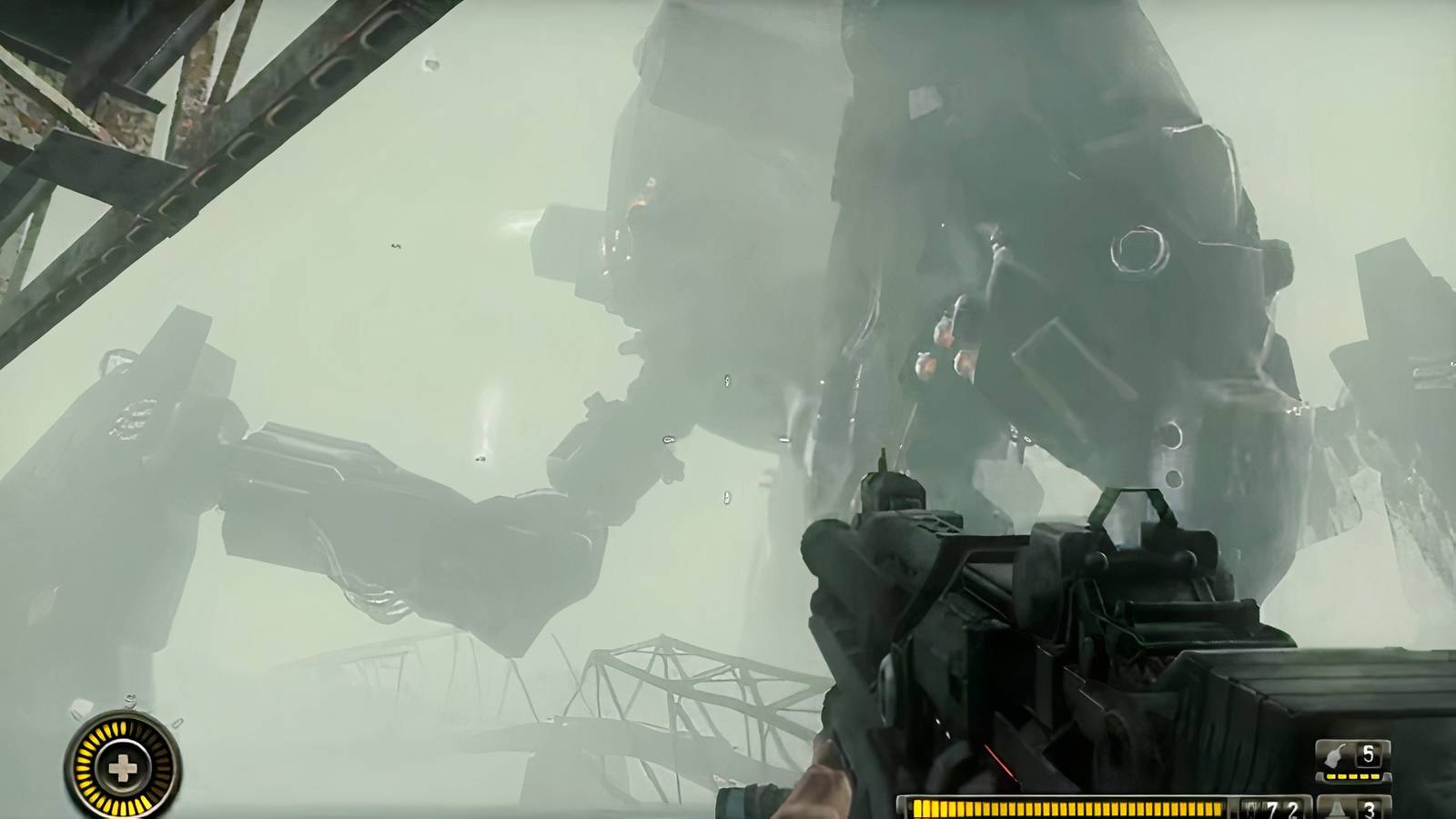
Resistance 3
Ended With A Bang, Sold To A Whimper
- Sold just 180,000 units in its first month, less than one-third of Resistance 2’s first-month performance.
Resistance 3 was a victim of circumstance. It was the culmination of a PS3-exclusive trilogy from Insomniac Games that was, in many ways, a response to the success of Halo on the Xbox. However, Resistance 3 had something on every major FPS franchise of the time. It was grittier than Halo, more fantastical than Call of Duty, with more interesting weapons than Battlefield and more interesting enemies than Killzone. Resistance 3 is a truly special game, but it couldn’t have been released at a worse time.
Launching in 2011, the same year as Battlefield 3, FEAR 3, Crysis 2, Duke Nukem Forever, Killzone 3, Rage, and Call of Duty: Modern Warfare 3, the unfortunate truth is that Resistance 3 was buried under a sea of similar titles with more hype behind them. Many of those aforementioned titles didn’t perform all that well either — critically or financially — but their word of mouth was much stronger. Couple that with Resistance 3’s adherence to more old-school FPS mechanics, like health packs instead of regenerating health and a weapon wheel instead of a primary-secondary roster, and despite how great its campaign is, it just never took off.
Titanfall 2
Retroactively Elevated To Classic Status
- Sold 385,000 units in its first week, about 75% less than the first game despite being a multiplatform launch.
Hindsight is 20/20, and boy, is that true with Titanfall 2. A game that, today, is considered one of the best single-player FPS campaigns of all time struggled a lot at launch. Much like Resistance 3, it was a victim of circumstance, releasing smack in the middle of Call of Duty: Infinite Warfare and Battlefield 1. An FPS would need to be the second coming of Half-Life to perform well in that release window, and as good as Titanfall 2 is, it’s not that good.
Despite great word of mouth and consistent discounts aimed at encouraging players to give it a shot, Titanfall 2 still underperformed its predecessor, which is likely why a third sequel has yet to materialize despite vocal and persistent interest from the gaming community. There’s still time for that to change, but with Respawn’s attention split between Apex Legends and the Star Wars: Jedi series, the franchise may be on the shelf for a while yet.
Bulletstorm
A Fun-Focused Arcade Shooter That Was Poorly Marketed
- Took two years to reach 1 million sales, and failed to break even financially.
Another FPS casualty of the stacked 2011 release lineup, Bulletstorm had trouble conveying what it was about. Its world was loosely reminiscent of Borderlands, but it had a more melee-focused combat system, and the writing was brazenly goofy. Meanwhile, gameplay had high-score numbers popping out of enemies and a slew of environmental kill options, drawing the “shooter” aspect of its first-person shooter label into question.
Then there was the Fox News controversy, where a Fox reporter (baselessly) linked Bulletstorm to a rise in sexual assault cases two weeks before the game’s official launch, damaging its reputation before it was even available for purchase. With a slew of other FPS games launching that year (including Killzone 3 on the same day), Bulletstorm never stood a chance, but it does deserve a second chance if you’re looking for an over-the-top shooter to try out.
Rage 2
Hurt By A Lack Of Name Recognition
- Only managed to match 25% of the original game’s first-week sales.
There was a lot of hype surrounding the first Rage. It was a new IP from id Software, the studio that all but created the FPS genre with Wolfenstein, Doom, and Quake, and it boasted some of the most detailed graphics that anyone had ever seen (at the time) and some impressively reactive enemy AI. The final product was… a bit lackluster; not bad, but a bit repetitive and lacking in variety. Rage 2, released 8 years later, sought to amend that, and it largely succeeded.
This sequel addressed virtually every complaint about Rage. The world was too brown and gray? Rage 2 is an explosion of color, with bright purples and blues in everything from the environment to combat abilities. Combat was too same-y? Rage 2 is almost a power fantasy, with combat abilities that encourage aggression and movement over cover shooting and ammo management. Exploration was too empty? Rage 2 features a massive open world where vehicle combat and racing can happen at any time and side content is hidden everywhere. The issue was, unlike the first game, which had a massive hype wave behind it, no one was all that excited for Rage 2’s release almost a decade later, and without that momentum, it failed to meet expectations.
Singularity
The Coolest Time-Travel Shooter You’ve Never Heard Of
- Released in the middle of summer with almost no marketing from Activision, and sold less than 400,000 units as a result.
Singularity is one of those games you may have heard of in passing, or not at all, but very few people actually played it. It’s an over-the-top shooter that gives you time-travel abilities for both combat and narrative purposes. It certainly doesn’t rewrite the book on FPS games, but it’s a fun and unique game that not enough people played.

‘Singularity’ Review
While it received little to no hype and borrows from numerous games before it, Singularity is an incredibly satisfying, fun shooter…
“It’s better than you expect it to be” was a common sentiment among critics, who were generally pretty pleased with Singluarity and reviewed it as such. However, Activision sent this game out to die, with the most barebones marketing campaign you can imagine and a release date right in the middle of the dry summer months. This is largely what did Singularity in. It’s not clear why Activision gave up on it, but it’s worth a revisit today, because there’s still nothing like it.
Battlefield Hardline
A Departure For The Series Led To A Departure By Consumers
- Despite being the best-selling game of March 2015, it is still considered a financial failure.
Stop me if you’ve heard this one before. A major publisher purchases an up-and-coming studio with some hit games under its belt and a clear specialization in a particular genre. Then, the publisher taps that studio to develop a game in a completely different genre. When that game performs poorly, the publisher closes the studio. Cue: Battlefield Hardline, an entry in the storied Battlefield franchise developed for EA by Visceral Games, the team behind the video game adaptation of The Lord of the Rings: Return of the King, the GTA-like duology based on The Godfather, Dante’s Inferno, and, of course, the Dead Space trilogy.
That list of games is to emphasize where Visceral Games was successful in the past and how none of those games bear any similarity to a Battlefield game. Not only that, but Battlefield Hardline was a major departure for the series itself. Instead of a military shooter, it was a cops-and-robbers story set in Miami. In short, it wasn’t going to lure in Visceral Games fans, and it did everything possible to turn off Battlefield fans as well. It’s unfortunate, because when played on its own terms, Battlefield Hardline is great. The story is engaging, the stealth is excellent, and the multiplayer is on par with any other game in the series. None of that worked to boost its sales though, and as a result, Visceral Games was closed down just two years later.
Medal Of Honor: Warfighter
A Comeback Attempt A Few Years Too Late
- First-week sales were less than half of its 2010 predecessor’s, effectively sunsetting the Medal of Honor franchise.
In the mid-2000s, Medal of Honor was the top dog in the military shooter genre, while Call of Duty was the more niche franchise. MoH had the large-scale spectacle, while CoD was more realistic. How the tables have turned. Following the success of Call of Duty 4: Modern Warfare, Medal of Honor tried to pivot to a more cinematic, narrative-driven formula with an expansive online component. The first game, 2010’s Medal of Honor, sold reasonably well. Its sequel, Medal of Honor: Warfighter, did not.
It’s still a fun game, one that any fan of Call of Duty who may be disillusioned with the franchise’s recent single-player endeavors should check out. It’s a linear, cinematic campaign with solid shooting mechanics, excellent visuals, and lots of action-packed set pieces. It even has an official soundtrack composed by Ramin Djawadi of Game of Thrones fame. Could it compete with Call of Duty at the height of its power? No way, but it’s still a solid military FPS that, unfortunately, looks like the end of the Medal of Honor franchise.
Prey (2006)
A Weird Sci-Fi Shooter That Was Successful, But Not Successful Enough
- Initially a commercial success, but not enough to preserve its sequel.
2006’s Prey is an interesting case because, by all accounts, it was a financial hit, selling over 1 million copies in its first two months and contributing to the early success of the Xbox 360. It’s a weird little sci-fi shooter starring an Indigenous protagonist that even featured portal tech a year before Portal’s debut. The game was in development for a long time, dating back to 1995, and its eventual release was praised by critics and fans alike. This success quickly led to a greenlit sequel shortly before Bethesda acquired the rights to the franchise in 2009.
Despite the excitement generated by Prey 2’s reveal at E3 2011, Bethesda chose to cancel the sequel just a few years later, citing development troubles. It’s fair to say that, if Prey (2006) had been a massive success, more effort would have been put into rescuing its sequel. Instead, Bethesda repurposed the franchise name and released 2017’s Prey, which, despite sharing a title, had no connection to the 2006 game. As for Prey 2017’s success…
Prey (2017)
Same Name, New Franchise, Same Sales Issues
- Sold significantly less than Dishonored 2 at launch, which was itself considered to have underperformed financially.
The repurposing of Prey into a new franchise didn’t pay off. Arkane’s Prey from 2017 is an immersive sim in the vein of Dishonored and Deus Ex, but with a sci-fi horror spin. Those who played it, loved it, including the critics, but it never found a mainstream audience. One reason for this was that review copies were only provided to outlets the night before Prey’s launch, which significantly delayed review scores and likely scared off some day-one buyers.
However, it’s also just a niche game. It’s an FPS without a lot of shooting, an open-world game where the “world” is just a big space station, and a horror game where the horror is more subtle than in-your-face. The naming convention probably caused a lot of confusion as well. Prey is an unfortunately maligned “series,” one that features two stellar games that both struggled to find consistent success in the gaming marketplace.
System Shock 2
The Greatest Financial Failure Game Of All Time?
- Sold just 60,000 copies in its first eight months.
Considering its pedigree today, the sales numbers for System Shock 2 are jaw-dropping. It sold just 60,000 copies in the eight months following its launch. That’s even more surprising given the nearly unanimous praise it received from reviewers. Looking Glass Studios, which was kept afloat by the modestly disappointing sales of the first System Shock, likely couldn’t have imagined the sequel performing even worse, and yet that’s exactly what happened.
Sometimes, creations that are ahead of their time don’t perform well at first blush. The same can be said for classic films like Blade Runner and The Thing, and System Shock 2 is very much in that same realm. Not only is it a cult classic today, but it is also considered massively influential on the direction of the FPS genre in the years that followed. It was a formative game for the immersive sim subgenre and is often ranked as one of the greatest games of all time. The game’s main villain, SHODAN, is similarly ranked as an all-time great villain in gaming. This sci-fi horror shooter has a stellar reputation today, and made the careers of creative icons like Ken Levine, but in its era, it was a nearly catastrophic failure.
16 Best Open-World FPS Games, Ranked
The FPS and open-world genres are two of gaming’s most popular. Put them together, and you’ve got a serious recipe for success.
