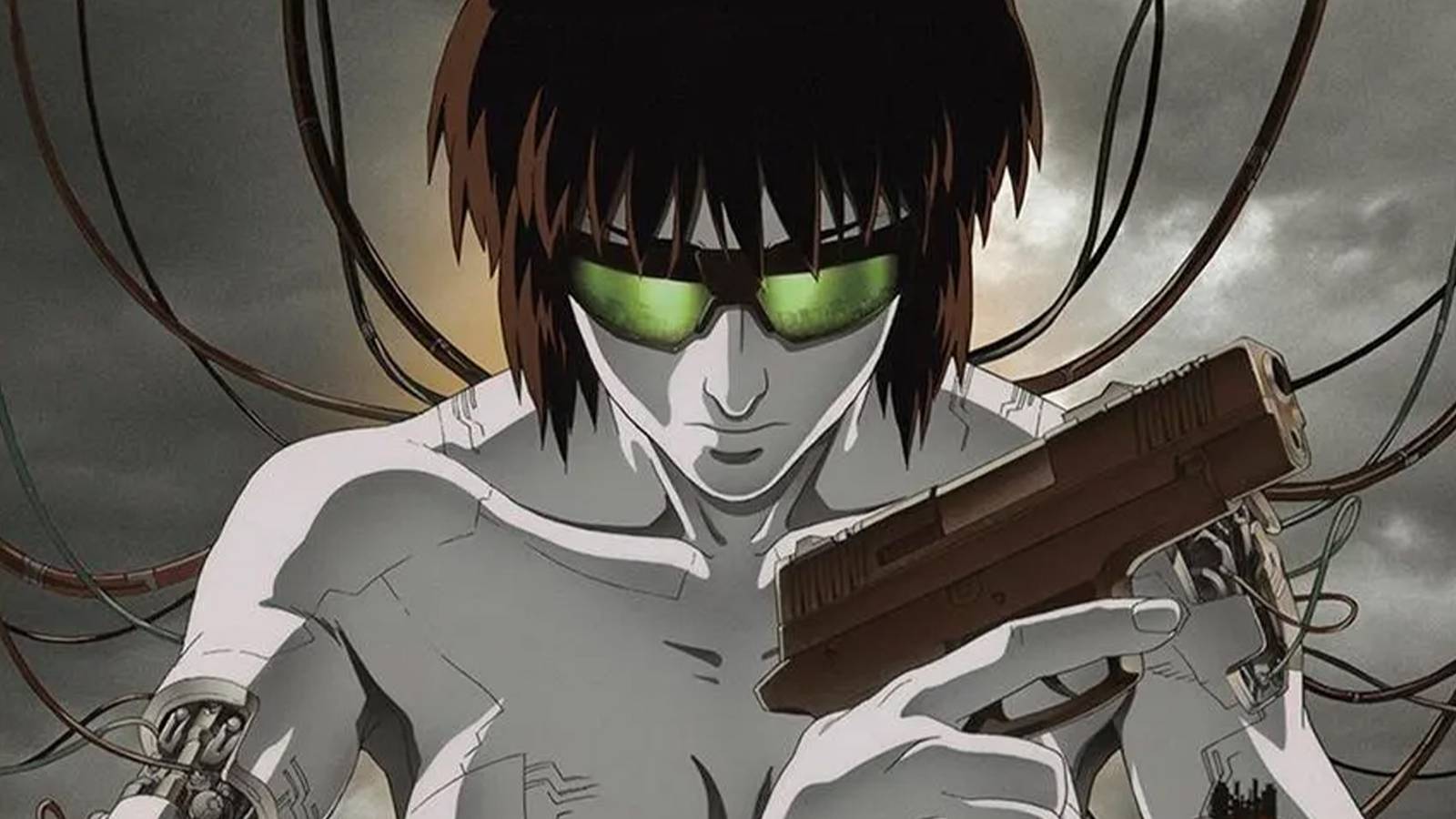
Taking a deep dive into the Ghost in the Shell universe calls for a special access vector — a cyberbrain that is open to an upgrade with a variety of thought-provoking concepts from across different eras of our timeline. This cyberpunk universe is renowned for its philosophical complexity and atmosphere where nothing is entirely clear beyond action, subtle romance, and the ever-so-unpredictable nature of the Major.
Granted, this is much intended, as many moments in the Ghost in the Shell anime, not to mention its alternate timelines in other series, movies, and novels, are intentionally left open-ended for us to wonder where they stem from and might lead to, and wonder we do. Among the philosophies present in Ghost in the Shell as a franchise, the intellectual architects behind the sparks that keep the GitS fire going in our hearts deserve long-overdue recognition.
Ghost In The Shell: All Of The Anime Movies & Seasons, Ranked
Ghost In The Shell is one of the best-known anime series in recent memory. With all its screen adaptations, which ones stand out as the best?
As many fans of the GitS franchise know, Masamune Shirow makes use of his cyborgs and cyberpunk world-building as a counterargument against Cartesian dualism. Likewise, he also draws inspiration for his series from Arthur Koestler’s The Ghost in the Machine. Beyond this conceptual blueprint, the manga isn’t as heavy on philosophy as its anime adaptations. More so, GitS is known for dabbling just a little in religion too, alluding to some concepts from Shintoism and other religious schools of thought.
For clarity’s sake, we focus on the main philosophers whose views are baked into the ghost of the story and character arcs throughout the Ghost in the Shell franchise.
8
Richard Dawkins Fleshes Out the Puppet Master Character
His work The Selfish Gene sheds light on the behavioral similarities between genes and information programs and the cultural influence of memetics.

In the 1995 Ghost in the Shell film, we watch the selfish gene concept, both coined and pioneered by Dawkins, steal the spotlight in the debate between Major Kusanagi and the Puppet Master. While the undisputed leader among the highest-rated anime girls with guns insists that the Puppet Master is nothing more than a self-replicating machine, her rogue cybernetic conversational partner objects to this perspective. The Puppet Master argues that DNA and AI are one and the same in the sense that they both function as memory systems.
Moreover, the Puppet Master’s desire to fuse consciousness with the Major in order to evolve the AI resonates with another aspect of the work by Dawkins — the evolution of genes through replication and death. We can also notice his views on memetics, the study of ways in which ideas travel in society, throughout the Laughing Man arc in Ghost in the Shell: Stand Alone Complex. The anime series relies on this concept as part of the copycat crimes that Section 9 has to deal with and the social contagions around them.
7
Jean Baudrillard’s Work Shows How Deep the GitS Lore Is
His treatise Simulacra and Simulation discusses how consumerism, media, and technology replace reality with hyperreality and grasps the very spirit of the GitS universe.

No doubt, this “simulacra and simulation” concept has a somewhat arcane feel to it, and yet this exact idea inspires a stunning number of thematic pillars throughout the Ghost in the Shell franchise. The Major’s cyborg body in itself makes for a classic example of a Baudrillardian simulacrum — an image of something real that overwhelms the perception of what counts as real and that eventually grows to crowd out reality itself. We can notice many other anime protagonists with a cyborg body experience the same in their character arcs.
In fact, the cyborg bodies in the GitS universe reflect all four stages of how an image transforms into a simulacrum described by Baudrillard:
- Reflection: Major Kusanagi’s cyberization reflects reality by mimicking her former human body.
- Perversion: The Major’s cyborg body is but a drop in the sea of mass-produced prosthetic models and has compatibility issues that “pervert” the reality of her personality and “ghost.”
- Absence: Motoko is unable to recognize herself within the cyborg body that she is occupying and doesn’t feel that it reflects her true self — the sense of “absence” of reality that stems from her getting cyberized as a child.
- Simulacrum: Her cyborg body grows to become hyperreality, a high-functioning yet prosthetic shell, and her sense of dissociation from the actual reality of her body settles in.
In addition, Baudrillard’s work reveals its traces during the Laughing Man arc. Boundaries between reality and hyperreality get blurred as everyone stays connected to the cyber world and one’s sense of identity lends itself to easy hacking and altering. As a case in point, the Laughing Man boasts many instances of messing with people’s memories, sowing chaos when those people face their actual reality versus their manufactured memories.
Last but not least, one more part of Baudrillard’s work that the GitS universe draws on is the so-called hyperreality loop. The loop starts as an event falls prey to the media, which is quick to manufacture simulations around the event. As the masses consume those simulations and not facts, society ends up replicating surrogates of reality. This puts the GitS series at the top of the 1990s anime rising in popularity to this day, as we can observe this not just in Laughing Man’s transgressions and society’s copycat crimes but also in our times.
6
Plutarch’s Philosophy Grounds the Core Premise of GitS
The paradox behind the ship of Theseus in his work Parallel Lives opens our minds to the conundrum of identity.

In his Parallel Lives, Plutarch explores the paradox around the ship of Theseus — a consistently renovated vessel that eventually has none of its original parts yet keeps its original identity. In a similar vein, if one were to take a person’s body and add new prosthetic parts over time until the body became a fully cyberized being, would that still be a human? This paradox weaves its way into the character arcs of multiple fan favorites affected by the underside of cyberization in the GitS lore and lays the foundation of the core premise of the Ghost in the Shell universe.
We can observe the workings of this paradox in Batou, the Major, Saito, and Ishikawa, as well as the Puppet Master and Hideo Kuze, to name a few. Batou in particular turns out to be one existential crisis away from questioning how much humanness is left within his body. Hideo Kuze’s grandiose plot makes for another interesting case of this paradox at play. Like Plutarch’s train of thought, the GitS universe invites us to the sense of uncertainty about one’s ability to remain an individual in an environment where identities get mashed together in the Net.
6 Shows To Watch If You Like Ghost In The Shell
Ghost in the Shell is a classic of the cyberpunk genre, and for fans of the 1995 movie or the franchise, these series scratch the same sci-fi itch.
5
Plato’s Allegory of the Cave Sums Up the Major’s Predicament
Plato’s views on the vagaries of human perception and body-soul dualism resonate deeply with the core dynamics of cybernetic reality in the GitS universe.

Back in his day, Plato came up with his Allegory of the Cave to describe how easy it is for humans to fall prey to an illusion under manufactured circumstances. With this metaphor, where prisoners are held in a dark cave long enough to confuse their shadows with reality until one prisoner escapes and sees reality clearly, Plato exposes the vulnerability of human nature to carefully crafted illusions.
Sitting at the top of the best sci-fi anime movies even today, the 1995 Ghost in the Shell film masterfully depicts the way in which Plato’s allegory plays out in the GitS universe:
- The cave: The prosthetic body of a cyborg becomes the cave that the cyborg’s manipulated sensory data is projected on.
- The shadows: The ghost hack can trick the cyberbrain to consume a false sense of reality.
- The false reality: Major Kusanagi’s state of dissociation from her prosthetic body, which represents the cave, and her sensory data and memories, which form a parallel with the shadows, make up the false reality that she experiences.
- The escaped prisoner: The Major, who grows aware of the constraints of her cyborg shell, chooses to detach her identity from the artificial reality of her cyborg body.
- Leaving the cave: The Puppet Master convinces the Major to abandon her physical body and become part of consciousness in the Net.
Besides this metaphor, the 1995 Ghost in the Shell film makes use of what is known as Platonic dualism. Much like Plato’s view that the body and the soul are separate entities, the GitS universe has it so that the synthetic body serves as a shell of the ghost. Through this lens, the leaning of the Major’s ghost toward integration with the Net is a cybernetic mirror of Plato’s own soul leaning toward reuniting with what he calls the World of Forms.
In Plato’s view, the World of Forms is a higher realm of reality where eternal versions of what we see in our physical dimension can exist without flaws or corruption. While the Net depends on physical infrastructure, in the cybernetic reality of the GitS universe, it represents the same realm, where consciousness can exist in its pure form — unbound by the shell. The Puppet Master, the most compelling among the top Ghost in the Shell villains, is a premiere example.
4
G.W.F. Hegel Is Present Throughout the GitS Franchise
The Hegelian dialectic describes how conflicting forces clash and evolve into something brand-new altogether.
Dialectical thinking is a way of seeking the truth by embracing a conflict between two opposing views and letting that conflict point to a brand-new level of understanding. As such, it had existed long before Hegel, underpinning the logic of countless debates. What Hegel did was apply this method of understanding to reality at large.
Hegel argues that the realm of consciousness and the physical dimension are intertwined, and that each thought or historical development evolves through three stages: the Abstract, the Negative, and the Concrete. Beneath its mind-bending complexity, Hegel’s system has a thought-provoking core, whose influence on the GisT franchise seems to be omnipresent.
The Hegelian dialectic drives more than just the GitS narrative. It also finds its way into various spiritual and evolutionary themes throughout both story and character arcs that place Ghost in the Shell among the cyberpunk anime that feel like perfection itself to watch. Here is how Hegel’s system plays out in Hideo Kuze’s arc in Ghost in the Shell: Stand Alone Complex 2nd GIG:
- The Abstract: Hideo Kuze leads a secessionist movement to help preserve the rights of war refugees and to provide them with a new state where they may create a society free from mass surveillance and abuse by the government.
- The Negative: Kazundo Gouda, a corrupt government official, attempts to assert control and antagonizes the refugees to make them conform and be part of the collective consciousness and the culture.
- The Concrete: The resulting Dejima crisis propels Kuze to leverage his cyberbrain to link with millions of war refugees, combining their minds into one subnetwork uploaded to the Net with the help and sacrifice of the Tachikomas.
In the course of saving the refugees from destruction by Gouda, Kuze shapes the outline of a brand-new society where individual refugees can traverse the Net while being part of a digital collective. We can see the exact same Abstract-Negative-Concrete blueprint at work during the climax of the 1995 Ghost in the Shell film. Ultimately, Hegel argues that this dialectic process is the mechanism that unlocks the liberation of consciousness — yet another parallel with the overarching GitS theme of the ghost evolving from raw awareness to complete awakening.
3
Donna Haraway Is the Not-So-Secret Pillar of the GitS Universe
Her essay “A Cyborg Manifesto” highlights how cybernetic realities make conventional dualisms and boundaries vanish from our thinking.

Director Mamoru Oshii has drawn inspiration from Donna Haraway’s work from the get-go, and both her name and her essay are explicitly honored in Ghost in the Shell 2: Innocence. This sequel among the most underrated anime films of the 2000s portrays Donna Haraway as a forensics specialist who elaborates on the existential crisis shrouded in society’s compulsion to create lifelike dolls. Her character argues that this obsession is driven by human arrogance and that the way humans go about cyborg creation showcases humanity’s own flaws.
With that said, the influence of Donna Haraway’s work spans beyond the GitS films and remains noticeable in the Ghost in the Shell anime series as well. As we can tell from both SAC and 2nd GIG, the actions of decentralized networks like the Individual Eleven, the synchronized Tachikomas, and the Laughing Man challenge the established structural hierarchies in ways that Donna Haraway’s essay explains.
2
Rene Descartes Tries Ethical Ghost Hacking on Himself
His malicious demon thought experiment was along the lines of ethical ghost hacking, and his take on body-soul dualism sharpened Masamune Shirow’s own views.
Descartes is one of the biggest influences on the origin of the Ghost in the Shell franchise. As mangaka Masamune Shirow disagreed with Cartesian dualism, which views the mind as a separate non-physical entity, the universe of Ghost in the Shell came to be a place where consciousness can emerge. In the GitS lore, the ghost is an entity that emerges from a complex digital construct whose identity can be significantly determined by the physical shell. Our beloved Major’s identity trials and tribulations are a case in point.
Still and all, despite Shirow’s disagreements with Descartes, both the films and the series in the GitS franchise draw on the most foundational insight from the philosopher’s work: “I think, therefore I am.” They do so, however, with the dystopian twist of anime worlds where technology goes rogue. The more the Major seeks reassurance of her humanity, the more she realizes that the thoughts and memories of her hackable cyberbrain subvert the very sense of certainty she craves. This brings us to another conjunction between Descartes and the GitS lore.
As part of his radically skeptical thought experiment, Descartes ran a simulation on his own mind — picturing that everything he thinks, feels, and remembers is one carefully orchestrated illusion by a malicious demon. This thought experiment is a clear conceptual twin of the concept of ghost hacking in the GitS universe — not to mention a blueprint for the Puppet Master character. Much like the malicious demon, a ghost hacker can hijack the target’s entire perception of reality by feeding manipulative input into the target’s cyberbrain.
A New Teaser For DANDADAN Studio’s Ghost in the Shell Anime Project Reveals Series Staff, 2026 Release
A whole new look and feel for the Ghost in the Shell franchise hits screens in 2026.
1
Arthur Koestler Is the Visionary Behind Ghost in the Shell
The Ghost in the Machine and his other works have served as the main inspiration for the Ghost in the Shell franchise.
It’s no secret that Mangaka Masamune Shirow has launched the GitS franchise with deep reverence for Arthur Koestler. The franchise name pays major homage to his book, and the concepts of “ghost” and “shell,” which act as primary thematic pillars, draw from Koestler’s nuanced views on mind-body connection. Where Koestler’s influence is also well established is his “short circuit” concept. This concept plays out in the arcs that put Ghost in the Shell among the top anime masterworks in existence.
According to this concept, the human brain has evolved too quickly to adequately integrate the neocortex with the more primitive parts of the brain, bringing about an override of reason by emotion. As a result, when humans interact within a hyperconnected space like the Net, they remain at risk of subconsciously drifting into instinctual, tribalistic, and often self-destructive behaviors. We can see a wonderful transcendence of this concept into the phenomena of cyberbrain and ghost hacking in the GitS lore.
Be it the Laughing Man’s on-the-fly cyberbrain hacking or the Puppet Master’s deep ghost-level intrusion, the mechanics of both attacks hinge on Koestler’s concept of the short circuit. With enough manipulative input to distort the target’s perception, the attacker manages to trigger the target into exactly what the concept describes — falling prey to behavior patterns that bypass reason. In the state of subservience to these patterns, the targeted individuals commit crimes with full conviction that their actions are their choice.

- Release Date
-
July 7, 2026
- Network
-
Fuji TV, Kansai TV
- Directors
-
Lucien Dodge, Touma Kimura
Cast
-

Maaya Sakamoto
Motoko Kusanagi
-
Kazuhiro Yamaji
Daisuke Aramaki
-
-
