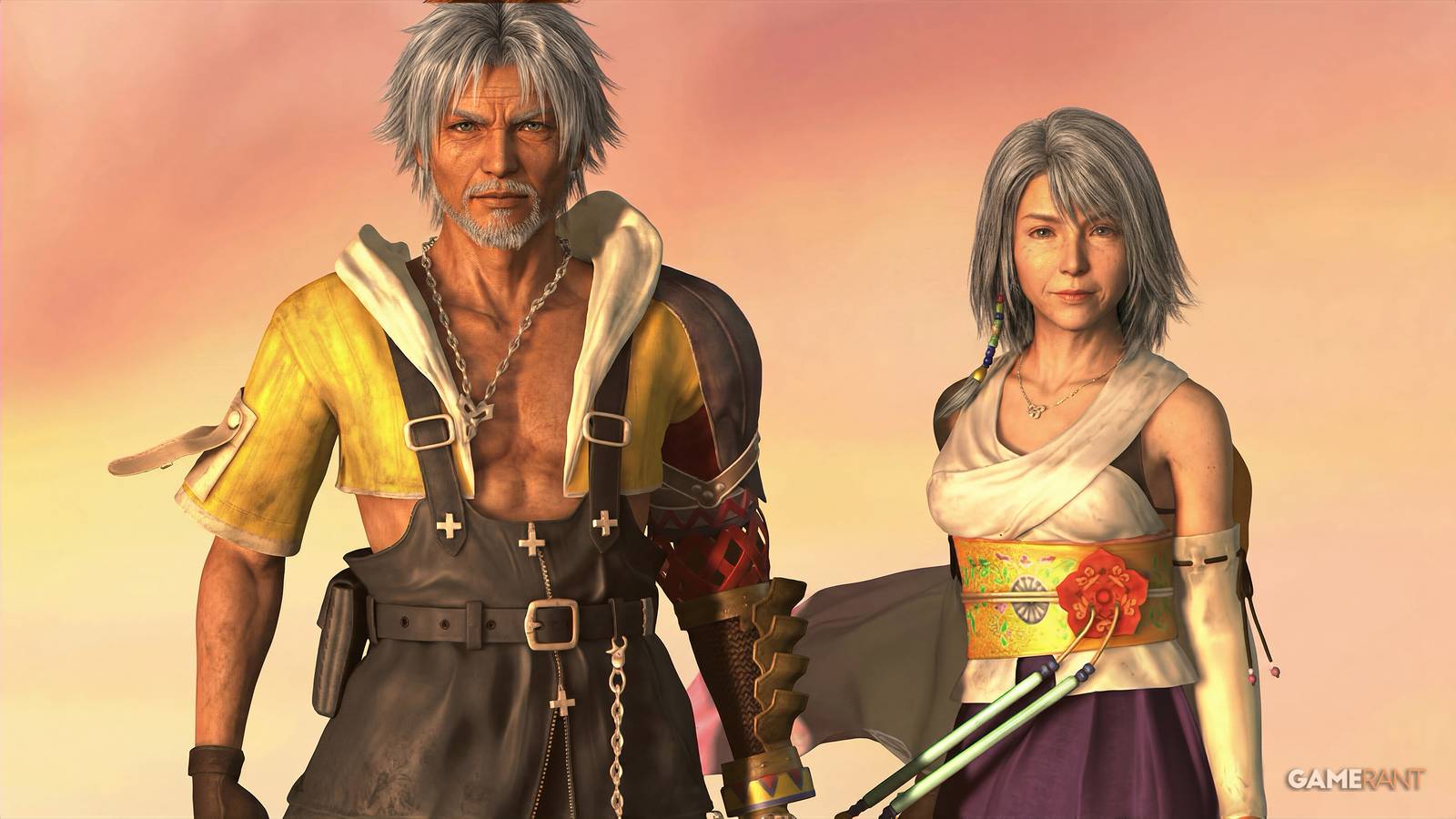
I can feel my back ache when I say this, but Final Fantasy 10 turning 25 this year, and I'm not sure I'm ready to admit it. It feels like just yesterday that I had gone to the local pawn shop and bought a PS2 with my hard-earned allowance just to play the 10th main game in one of the best RPG franchises ever made. I had a lot more free time then, and I didn't feel the least bit guilty about spending most of it on a video game like that. Sure, it got in the way of my homework and chores, but it was all worth it. To this day, I have yet to have an experience comparable to Final Fantasy 10not because there hasn't been a better game, but because nearly 25 years ago it changed the trajectory of the franchise in a way that few entries have come close to doing.
To be clear, Final Fantasy had already been developed before FF10especially after jumping from 2D to 3D with Final Fantasy 7. And that's not all Final Fantasy 10s ideas stuck around for a long time, as the series has long been known for changing major systems with each new installment. But it introduced several key elements that have since either become franchise staples or things the series is simply no longer afraid to do. When examining its impact on Final Fantasyit's hard to imagine going back to how the series was before Final Fantasy 10s launch. If nothing else, it shows my age, it shows your age, and it shows how important this game was when it was released in 2001.
From Coffee Truck to Critic: How Final Fantasy Marked Every Step of My Life
Final Fantasy appeared during late nights, rough seasons, and defining moments, and embedded itself in my history long before I realized how deeply ingrained it was.
25 years ago, Final Fantasy 10 changed the trajectory of the franchise
I will say up front that many of the Final Fantasy 10The biggest innovations were due to the unprecedented power of the PlayStation 2 console at the time. It was a huge moment for gaming, as the PS2's hardware allowed for great leaps in visuals and presentation, especially when it came to character models, cutscenes and voice acting. Where the PS1 showed that 3D could work, the PS2 fully realized it with more detailed environments, larger spaces and more believable animations. It essentially established what games could be, pushing them towards more cinematic storytelling and making it easier to push genre boundaries. Final Fantasy 10 ultimately all capitalized on this, which is largely why it had such a huge influence on Final Fantasys future.
Who is that character?
Identify the silhouettes before time runs out.
Start
Identify the silhouettes before time runs out.
Easy (7.5s) Medium (5.0s) Hard (2.5s) Permadeath (2.5s)
The introduction of voice acting
Final Fantasy 10The biggest innovation was undoubtedly the introduction of voice acting. Since its launch in 2001, the series has featured voice acting to some degree in nearly every game, mainline or not, effectively making its stories feel more like playable movies than anything released before. In fact, I openly admit that I once recorded every footage from Final Fantasy 10 on a blank VHS tape, making sure each one would occur right after the last, just so I could sit back and watch it as if it were a real movie. It was like nothing I've ever experienced, although the voice acting was certainly nothing to write home about.

The death of the traditional overworld map
Then it was the death of Final Fantasys traditional overworld map that came with it FF10. From the original Final Fantasy By Final Fantasy 9whether early in the game or later, players would travel between cities and dungeons via a zoomed-out, abstract overworld where the player character was almost as tall as a mountain in the background. Final Fantasy 10 eliminated that entirely, presenting Spira as a series of interconnected, scaled, and fully 3D zones. Since then, the classic overworld map has never made a comeback Final Fantasy series, although some entries like Final Fantasy 15 chose an open world.
To this day, I have yet to have an experience comparable to Final Fantasy 10not because there hasn't been a better game, but because nearly 25 years ago it changed the trajectory of the franchise in a way that few entries have come close to doing.
The end of pre-rendered backgrounds
Final Fantasy 10 also ended the era of pre-rendered backgrounds as visual language for the series. Final FantasyPS1 era (FF7, FF8, FF9) was known for its gorgeous, pre-rendered 2D backgrounds overlaid with 3D character models. However, since the PS2 could handle much higher polygon counts, Final Fantasy 10 featured fully 3D environments for the very first time in the franchise. It allowed the camera to pan, track and sweep during cutscenes and gameplay, permanently ending the static camera era of the franchise and establishing a very cinematic visual standard for the series.
The era of direct sequels
Final Fantasy 10 was also the first game in the series to introduce the concept of direct sequels, but Final Fantasy 10-2 was not launched until 2003. Historically, Final Fantasy followed an anthology format, where each numbered entry offers a whole new universe with new characters, a new world, and a new story. FF10 broke the golden rule with the release of Final Fantasy X-2. Since then, records such as Final Fantasy 13 and that Final Fantasy 7 Remake trilogy has implemented the idea after Square was able to prove that fans would actually buy direct sequels to established ones Final Fantasy worlds, although it was controversial to some.
Final Fantasy 10The biggest innovation was undoubtedly the introduction of voice acting.
Node-based character progression
Node-based character development was another innovation Final Fantasy 10 was put in tow, and the series hasn't really gone back to its progression roots since. Instead of incorporating the traditional “gain EXP, level up, get stronger system,” Final Fantasy 10 introduced players to the Sphere Grid (one of my all-time favorites Final Fantasy progression system, by the way). In it, players earned points for moving across a massive board where they manually unlocked stat boosts and abilities.

From there, things changed permanently for Final Fantasymoving it away from invisible, automatic stat growth towards highly visual, node-based progression systems. It ultimately paved the way for FF12s licensing board, FF13's Crystarium, and also the ability trees found in the modern action RPG entries.
Mid-Battle Party Swap
Finally, while FF10s Conditional Turn-Based (CTB) system was largely left behind, the game introduced the idea of switching party members mid-battle. Before FF10the characters players brought into a boss fight were the ones they stuck with. But FF10 allowed you to tag out characters on the fly, and that party management mechanic continued to influence later games such as Final Fantasy 7 Remake and Rebirth.
Final Fantasy 10 was more than just a game
But more than all the changes Final Fantasy 10 inspired, what sticks with me now is everything around. I can still see that version of myself sitting there with way too much free time, not thinking twice about spending an entire afternoon grinding, exploring, or just watching cutscenes as if it were a movie. Then there was no pressure to optimize my time or justify it. If anything, the only goal was to stay in that world as long as possible. It's a feeling that's much harder to come by now, and I think that's part of why this anniversary hits a little differently.
Final Fantasy 10 officially turns 25 on July 19, 2026, and it's a strange thing to sit with. It's easy to talk about it as a milestone for the series, but it also feels like a checkpoint to me. The industry kept evolving, the games got bigger, and life kept moving, but that experience never really left. Not necessarily because nothing has come close, but because you don't get the same moment twice. Some games become more than just milestones for a franchise, and instead mark a specific time in your life – and for me, Final Fantasy 10 will always be one of them.


- Released
-
December 17, 2001
- ESRB
-
T for Teens: Mild gore, mild suggestive themes, violence
